Table of Contents
Planning for Raising Equity Capital
Alternatives to an IPO – Reverse Mergers
Community Loan Development Funds
How To Prepare a Loan Request
How Investors Use Your Financial Statements
Planning for Raising Equity Capital
GETTING STARTED
Most new business ideas are viable. Yet most new businesses fail. Many fail because the entrepreneur does not execute the idea properly. Others fail for want of capital. There are two primary reasons businesses fail to raise the capital they need.
• The entrepreneur pursues the wrong sources of capital
• The entrepreneur fails to adequately plan for their search for capital.
The dictum “Ready, Fire, Aim”, unfortunately, is a formula for disaster when it comes to raising money. Chiefly this is because, for most companies, there are in truth, very few viable investor candidates, and getting in front of one ill-prepared — even though he or she is the one — dramatically increases the likelihood that they will pass on your deal.
| Don’t Forget: You must take the time and effort to plan your strategy. If you are starting a business, or raising money for one in its very early stages, you may only get one opportunity to raise money. Failure to raise capital may mean the failure of the business. |
The following paragraphs offer an algorithm for planning and meeting with angel investors. But in truth, it applies to any equity investor including institutional venture capitalists, investment bankers, and reverse merger candidates.
At the broad-brush level, the sequence of your tactics for raising equity capital is as follows.
• Business Planning. A big part of business planning means writing a business plan. This is fundamental to your search for reasons discussed below. But on a pragmatic level, you can’t set appointments until would-be investors have had a chance to look over your business plan. (See Chapter XX for strategies about writing a business plan.)
• Lead generation. You must find the kind of people who typically invest in early-stage deals. Once you learn where they are, you must qualify them.
• Follow-up, follow-up, follow-up.
• Closing.
BUSINESS PLANNING
Here are the planning steps to follow even before you make that first phone call to investors.
• Prepare a Business Plan. You must have a business plan for two very good reasons. First, if your initial contact with an investor is successful, he or she will request one. When an investor asks to see a plan, or even a plan summary, it needs to be on his or her desk the very next morning. At the very least it needs to go out first class mail, that day. If there is a delay of say three to six weeks between the request for a plan and its arrival, you can pretty much kiss that investor goodbye.
Second, investors ask a lot of questions. Seemingly, that’s all they do. And it’s only by writing a business plan that you can possibly hope to answer the kinds of questions that an investor will ask with the kind of conviction and authority which will win the day. Remember, there is not an entrepreneur on the face of this earth who raised a single penny simply by writing a business plan. They raised money by presenting their plan and using the thinking that went into its writing to defend their ideas, strategies, and tactics before investors. Flip ahead to the chapter titled Preparing a Business Plan (Add link) which discusses how to write a business plan.
| Taking Action: Consider using off-the-shelf business plan software. These programs can stimulate your thinking by confronting you with the kinds of questions which an investor would ask. |
• Determine Your Sizzle. The business plan is the steak. Now, what is the sizzle? What is the one-line answer to the first question the investor will ask: “What does your business do?” The response must be brief, understandable, and memorable.
For instance, if your business resells deep discount travel packages for unused vacations at luxury resorts to Fortune 1000 consumer products companies to use as fulfillment premiums, don’t say that. The investor’s eyes will start to glaze over at the word “unused.” Say: We are the business that makes luxury travel affordable for 50 million middle-income Americans. Then the investor will say “I see,” giving you the opportunity to say “Travel in the U.S. is a $60 billion market annually. With a market this size, there’s lots of niches, and we are operating in one of them which has little competition, and high margins . . . ”
Or, let’s say that your business offers marketing services to physicians for elective surgical procedures, which helps them overcome the ceilings on fees imposed by HMOs and other third-party payors. Don’t say that right out of the box. Instead say, “We are the new breed of marketing agency that every physician in the U.S. now knows that he or she needs if they hope to survive the changes in medicine . . .”
Statements such as these are your sizzle. They are succinct, memorable, and perhaps most importantly, repeatable. You want a sound bite which an investor can easily repeat to his or her fellow investors. Even Wall Street uses this trick. When venerable motorcycle maker Harley-Davidson went public, the pitch to investors was “Own a piece of an American icon.”
• Form an advisory board. Every industry has people who have succeeded. Reach out to these people and ask for their help in the form of serving on an advisory board. There’s a lot of psychology in why people readily agree to such a proposition. Many appreciate being recognized as a success. Others have that natural mentoring orientation which comes from being a successful businessperson. Some want to relive their previous success, while others would simply like to be part of a support system they wish they had when starting out.
But one of the true purposes of forming an advisory board is to help generate leads. When you start asking advisory board members about sources of financing, you will find that many willingly open up their Rolodex’s if they have been properly initiated. To a lesser extent, the purpose of forming an advisory board is to increase the comfort outside investors have with your team.
• Focus On Getting A “Lead” Investor. If you are raising equity capital privately, there’s little likelihood that you will run into one sugar daddy who will cut a check for the entire deal. It could happen, but it probably won’t. More likely, however, you will run into a lot of investors who will put in smaller amounts. These are helpful, but they should be found later. Initially, you need to focus all of your energy on finding the investor or investors who will take down 25% to 50% of your deal, and who by doing so, will provide a magnet for the smaller investors.
| Shop Talk: Investors and entrepreneurs often talk about the “lead investor.” This is the person or institution that makes the most significant financial contribution to the deal. Also, because a large investment by one entity can often attract other dollars, the lead investor is the one which is found first. |
• Seek Legal Counsel. Soliciting capital may provoke several state and federal securities laws. You do not want to unwittingly run afoul of these laws, an act which may cause you to return capital which you worked so hard to raise. Even though many deals are exempt from state and federal securities laws, there can still be a host of requirements on notification, documentation, and the number of investors who can participate in the offering. Raising money is hard. Don’t make it harder by unknowingly breaking the law.
| Don’t Forget: Investors are people too. In order to get a deal done, you must be able to move beyond the language of attorneys and accountants in your presentation, and provoke imagination and curiosity. |
• Prepare a Deal Summary. Technically, this should be the executive summary of your business plan. As mentioned in the chapter about business plans, the executive summary should be no longer than two pages, and must function as a stand-alone document. This summary must describe: the company, the product or service, the market, competition, key personnel, funding required, use of proceeds, and a historical and projected financial snapshot. To stay within the one to two-page length, you should write no more than one paragraph about each of these items.
• Get Referrals. If an investor is interested in learning more about your business after the first telephone call or meeting, he or she might want to talk to someone else such as a customer, a licensee, a franchisee, your accountant, attorney, or members of your advisory board or board of directors. Plan for this question by figuring out who should and will talk. That way, when an investor asks to speak with someone you can answer with a name and a phone number rather than by saying “I’ll get back to you on that.” Remember, you may never get the investor back on the telephone again. Whereas, if he or she is provided with an action step and takes it, the mating dance is still on track.
• Get Introductions. If your lead generation process turns up investors you do not know, then you must work ahead of time to get some kind of warm-body introductions. The best kinds are when someone calls ahead of you and warns you will call. When this happens, you will be able to have an initial telephone call with the investor nearly 100% of the time.
As a fallback, during the first conversation if you can say in your first breath “Our mutual acquaintance Peggy Bennett suggested contacting you . . . ” then your chances of the call being successful, that is the investor agreeing to look at something you send them, increase dramatically.
Former employees, trade associations, accountants, lawyers, or the person who supplied you the lead in the first place, all represent viable candidates to prepare the investor for your initial contact.
• Meeting Venues. If you have something in your factory or office worth seeing, such as people actually doing something, or products being made, then you should always try to get the investor on your turf for the first meeting. However, if you work in a hovel or at home, it may not be a good idea to let the investor see your space. If this is the case plan ahead of time a variety of places you can meet where you know what’s going on, such as the office of your accountant, or attorney, or hotel lobbies which you have been in and which can accommodate an intimate conversation.
| Taking Action: One technique that is sometimes used by companies raising money is the publication of a regular newsletter. This keeps investors and potential investors up on the company as it makes progress. |
LEAD GENERATION
If you ever trace your life’s path in total, you may see that where you have ended up, is to a great extent, the result of chance meetings and random events. The same theory can apply to raising money. You just never know who you will meet who will put you in touch with the person who will be your investor.
Here are some real life examples of such serendipity:
A turkey restaurant owner looking to expand, gets a referral, of all places, from the person who supplied him with ham (clearly not a major vendor) to a franchise development consultant. After that, it was almost biblical in the chain of names that led to the almighty investment capital. The franchise developer, named Bloomenthal had a friend by the name of Levine, who had a friend by the name of Rosen, who had a friend by the name Erlich, who had a friend by the name of Freidman, who knew a merchant banker named Miller, who did the deal.
Or consider this one. The president of a home-based care management company who had been raising money gets the opportunity to make a presentation before an angel investor group. There are some 80 investors in the room; a target-rich environment. His company was met by the investors with all of the enthusiasm normally reserved for a blood test. But a funny thing happened. Prior to going “on stage” the entrepreneur was put in an anteroom with two other entrepreneurs scheduled to present that day. The entrepreneurs started comparing notes and swapping the names of investors they had met. Our health care entrepreneur diligently follows up on these leads, and among them finds his lead investor who commits $200,000 to his company.
Raising money is a lot like finding a job. You must network, network, network. Every person you meet, you need to ask for three more names. One entrepreneur who had diligently saved the business cards of every person he had met over the years sent each one a letter asking for their help in raising money or getting him in touch with investors. He got five investors this way, and a lot of encouragement for what he was doing.
If you are not such a pack rat, here are several paths you can take to start meeting investors. Many of these are described in greater detail in chapter 11, about angel investors.
• Venture capital forums
• Fund-raising seminars
• Venture capital fairs
• Venture capital clubs
• Private capital networks (See Chapter 12)
• Ace-Net (See Chapter 12)
• Professional services firms such as accountants and attorneys
| A Good Deal: Several electronic matching services such as ACE-Net, among others, provide quick and direct access to angel investors. These matching services may not lead you directly to capital right away, but they clearly have the power to start you digging in the right vein. (See Chapter XX – The Internet & Other Electronic Matching Services) |
MAKING CONTACT & FOLLOWING UP
Now it’s time to dial for dollars. Prior to picking up the telephone, you should have put together a business plan and (where possible) gotten some kind of entree to each of the investors you are going to approach. Now you must:
• Qualify The Investor. Your first task is to qualify your would-be investor. This must be done very early on in the process. After all, every investor has parameters and preferences, and if you don’t fit within them, you should probably spend your time on other potential investors.
The investor will ask you very early on in your first conversation who you are and what your company does, to which you should respond, “We are the business that makes luxury travel affordable for 50 million middle-income Americans.”
Then you might suggest some overall industry trends, but then you’ll need to pop the question: “Do you typically invest in companies such as ours?” If the person you are talking to doesn’t invest in companies like yours it’s time to gracefully bow out and move on. But remember, get three more names before you do.
• Answer Questions. If the investor has any interest, he or she will ask a lot of questions. This is where writing a good business plan pays off. Because you’ve thought every aspect of the business through, you should be able to manage these questions.
It’s important, however, to exude confidence and momentum in your answers. The investor is evaluating you from the moment the conversation begins. Equity investors are not like lenders in this regard. They are not relying on cash flows to get their investment back. They are instead relying on you, the entrepreneur, to build value and keep selling the business to other investors until the point where it gets sold to the public or another corporation. The upshot is, if you can’t be convincing to this investor, he or she is thinking you probably can’t convince the next investor down the road, and that ultimately, their investment will remain trapped inside the company.
The reason you want to show momentum is because you want to leave the investor with the feeling that things are happening quickly; that if he or she invested, their money would go to productive use right away, and not sit around in limbo while you figure out the nuances of getting the business to its next stage of development.
• Get A Meeting. Your objective during the initial contact is to get a meeting with the investor. If your list of potential investors is well qualified, meetings will come easily. If not, then getting an investor to agree to a meeting will be more challenging.
Generally speaking, if the investor is interested in meeting, they will request more information, such as a business plan or business plan summary. Don’t agree to sending it out without getting something in return. Specifically, you want the investor to agree to meeting on a certain date after they have reviewed the plan.
Now it’s up to you to make sure your business plan arrives on the investor’s desk the very next day. In addition, as practical, you want to include some kind of sample or tangible evidence of your product or service. If you sell imported, shelf-stable food products, this is easy. If you manufacture waterbeds, this is more difficult. Even in difficult situations, it’s worth considering creative solutions. Pictures, customer testimonials, videotapes among other items can sometimes help bring a product or service to life. Anyone can send a bunch of papers in the mail that pile up on someone’s desk. But product or service samples get picked up, toyed with, and considered.
• Managing Objections. Typically, seeking the first meeting is when you will run into the first wall of objections. “The product is not developed enough,” “The distribution channel is too crowded,” “Your management team is too thin,” “It doesn’t appear that you have established technical feasibility.”
If the investor is qualified to participate in your offering, then you’ve got to be tenacious at this point. Most of the time, when investors decline an opportunity, it’s because they don’t understand a certain aspect of the product, or the market or the technology, or your vision for the company. As a result, when an investor says no, they don’t want to meet, you’ve got to ask them why, and then show them where their thinking is off.
• Prepare a Formal Presentation. You cannot meet with an investor without having a formal presentation prepared. It may not get used, but better to need not have, because if you need it and don’t have it, you’re sunk. Remember, the investor is evaluating your ability to keep selling the company because it’s how he or she will eventually get their return. If you show incompetence in this arena, even if the company shows a lot of promise, it spells trouble for your capital formation efforts.
| AFTER YOUR FOOT IS IN THE DOOR The 20 minute pitch is standard operating procedure; you must be able to tell your story in this period of time. The underpinning of the presentation is your business plan. Thus in the time allotted you must cover the major sections of the plan. Overall you are trying to answer these questions in the investor’s mind: • What is the company and its strengths? • How has it performed? • Where is it going? • How is it going to get there? • What does it mean to me if they succeed? Whether you are meeting with one investor or a roomful, the best strategy is to walk them through a set of 10 to 15 slides, which punctuate your remarks. |
• Conducting The Initial Meeting. There are two very straightforward objectives for the first meeting. First, get the investor to like you. Second, get a second meeting. Entrepreneurs must have two objectives for their initial meeting with the investor. First, get the investor to like you. Second, get the investor to commit to doing some kind of action step.
You must get the investor to like you for a very simple reason. If he or she doesn’t, there’s very little chance that the deal you are proposing will ever happen. Unlike a lender, who bases his or her decision on credit quality exclusively, an equity investor is looking for some sort of personal chemistry, at least for earlier stage offerings. Without some baseline affinity for the entrepreneur and what he or she is doing, there is no basis for an investment. Also remember, that an equity investor can get romanced by business ideas and people, it’s unlikely a lender would change their lending criteria a single iota simply because he or she happened to like the entrepreneur.
But you must do more than simply have the investor like you. The meeting must close with some sort of action step on the part of the investor.
| BECAUSE WE LIKE YOU Getting other people to like you is the subject of another self-help book. But here are the concepts outlined in Part Two of perhaps the greatest book on the subject ever written on the subject How to Win Friends (Simon & Schuster) and Influence People, by Dale Carnegie. Read them over several times before you meet with a prospective investor. • Become genuinely interested in other people. • Smile. • Remember that a person’s name is to that person the sweetest and most important sound in any language. • Be a good listener. Encourage others to talk about themselves. • Talk in terms of the other person’s interests. • Make the other person feel important — and do it sincerely. |
Finally, keep in mind that just like the initial telephone conversation, you want to avoid ceding control of the process to the investor. Therefore, try to make the action steps conditional upon a second, and hopefully closing meeting. For instance: “So you agree to try our product for two weeks, and then meet with me to discuss your thoughts.”
CLOSING
If things have gone according to plan, the date for the second meeting should have been set during the first. But if not, getting this second meeting might take some effort, and a bit of follow-up.
Regardless, the second meeting is deal time. And even if it’s not deal time, it’s certainly the time to separate out the investors who are not worth your time to pursue any longer.
You must pop the question in a way that gets the investor involved in the decision-making process. Also, you must pop it in a way that forces the investor to declare their interest or lack thereof. Here is, in sample dialog form, how to do it:
Entrepreneur: We have met twice. I appreciate the time you have taken to understand my company. Now that you know a little more, and you clearly have some experience in these matters, I want to ask you an important question.
How much capital do you think we should be raising?
Investor: Well, to tell you the truth, I’m glad you asked that. Because I have studied your plan, and I think that you are going to need much more than the $500,000 you are looking for. I think you need $750,000. Not right away, but shortly after you commence marketing — which according to this plan could happen at the end of this year.
Entrepreneur: It’s comments like that that let me know I’ve chosen the right course of action by seeking out hands-on investors, who can provide not just capital but input. Ok, of that amount, $750,000, how much can you commit to?
Gotcha! At this point, the investor has very few courses of action. He or she can suggest a material amount, a small amount, or no amount. If the answer is none, you can say goodbye to that investor and move on. If it’s a small amount, you can solidify this investor’s interest by telling them you are looking for a lead investor and asking them if they will commit the dollars they just suggested when this investor is found. Most will say yes. If the answer is a large amount, then you have accomplished your objective of finding a lead investor.
Getting from a yes to actual dollars in the bank is beyond the scope of this work. However, if you have gotten this far in the fundraising process, you should have had at least some experience with an attorney who has significant experience in securities law. You will now need their counsel in drawing up the necessary subscription documentation, or understanding the securities laws exemptions you are taking advantage of.
| Taking Action: Here are five steps to suggest the investor take after the close of the initial meeting. Have the investor: 1. Read your business plan (assuming they have only read a summary to date). 2. Try your product or service. 3. Speak with one of your references. 4. Have his or her attorney or accountant call you. 5. Call someone he or she has worked with in the past that understands your industry. |
Angel Investors
| CAPITAL FROM ANGEL INVESTORS Definition or Explanation: Venture capital from individual investors. These investors look for companies which exhibit high growth prospects or have a synergy with their own business or compete in an industry in which they succeeded. Appropriate For: Early stage companies with no revenues to established companies with sales and earnings. Companies seeking equity capital from angel investors must welcome the outside ownership, and perhaps the surrender of some control. In addition, to successfully accommodate angel investors, a company must be able to provide an “exit” to these investors in the form of an eventual public offering or buyout from a larger firm. Supply: The supply of angel investors is large within 150 mile radius of metropolitan areas. The more technology driven an area’s economy is, the more abundant these investors are. According to Jeffrey Sohl, director of the Center for Venture Research at the University of New Hampshire, America’s 250,000 angel investors pump some $25 billion to $30 billion into growing businesses, each year. Best Use: Runs the gamut from companies developing a product to those with an established product or service, that need additional funding to execute some marketing program. Also, for companies that have increasing product or service sales and need additional capital to bridge the gap between the sale and the receipt of funds from the customer. Cost: Expensive. Capital from angel investors will likely cost no less than 10% of a company’s equity, and for very early stage companies perhaps more than 50%. In addition, many angel investors will charge some sort of management fee, in the form of a monthly retainer. Ease of Acquisition: Angels are easy to find but sometimes difficult to negotiate with, because they usually do not invest in concert, and may demand different terms. Range of Funds Typically Available: $300,000 to $5 million. |
WHY ANGELS?
For most small or new businesses, so-called angel investors are the most appropriate source of financing. There are many reasons for this. Some of the more fundamental and important:
• Angel investors are one of the most abundant sources of capital in the U.S. America’s 250,000 angels invest $25 to $30 billion each year in growing businesses.
• Angel investors typically provide equity capital. For most emerging businesses, equity capital is appropriate, because it is permanent, and does not require monthly or quarterly interest payments.
• Angel investors will typically invest in a business for reasons other than economic. A desire to help young entrepreneurs, and fill the role of the mentor they never had, is a reason frequently cited by angels about why they invest.
• The amount of capital that emerging businesses need, generally from $250,000 to $5 million matches the commitments which angels typically make.
| Shop Talk: The term angel investor derives its origin from Broadway. The wealthy individuals who typically financed lavish productions were dubbed angels, because of the small likelihood of ever realizing a return. |
STALKING ANGELS
Angel investors are at once difficult and easy to find. The situation is analogous to searching for gold. Generally, it’s difficult to find, but once you hit a vein . . . all of your hard works pays off in a big way. Here are the places to look to find angels.
• Universities. According to Bob Tosterud, executive director of the Council of Entrepreneurship Chairs, a council consisting of business schools with endowed entrepreneurship chairs, even schools with fledgling entrepreneurship programs generally have top-rated professors with ties in business and academia. Angel investors, says Tosterud, tend to hover near these programs because of the high level of new business activity they generate. Tosterud counsels that if you are looking for money, call the nearest university with an entrepreneurship program, and make an appointment to speak with the person running the program. Generally, he says they can point you in the direction of angels.
| A Good Deal: Angel investors often add value in areas where new or emerging businesses need help such as sales, marketing, strategic planning and finance. In addition, angel investors often prove to be an invaluable reservoir of contacts. |
• Business Incubators. According to the National Business Incubation Association (NBIA), there are more than 550 business incubators in North America. At first blush, incubators appear to be mere bricks and mortar that offer entrepreneurs reasonable rents, access to shared services, exposure to professional assistance, and an atmosphere of entrepreneurial energy. But, according to NBIA executive director Dinah Adkins, many business incubators offer formal or informal access to angel investors. While many of these relationships exist for the benefit of businesses actually in the incubator, not all do, and an incubator’s director may offer to make some introductions for you. On the other hand, maybe putting your business in a business incubator is not such a bad idea . . . .
To find a business incubator near you, see the chapter in this book titled Business Incubators. (Add link)
| ACTION STEPS TO FINDING ANGEL INVESTORS Here are 10 actions steps you can take to find angel investors in your area. 1. Call your Chamber of Commerce and ask if it hosts a venture capital group. Many such groups have a chamber affiliation. 2. Call a Small Business Development Center (SBDC) near you and ask the executive director if he or she knows of any angel investor groups. . Ask the SBA if you don’t know where an SBDC is. 3. Ask your accountant. If your accountant doesn’t know, call a “Big Six” accounting firm and ask for the partner handling entrepreneurial services. Ask him or her to point you in the right direction. 4. Ask your attorney. They always know who has money. 5. Call a professional venture capitalist and ask him or her if they are aware of an angels investor group. 6. Contact a regional or state economic development agency and ask if they are aware of an angel investor group. 7. Call the editor of a local business publication and ask if they know of any groups. They often write about such activity. 8. Look at the “Principal Shareholder’s” section of initial public offering (IPO) prospectuses for companies in your area. This will tell you who has cashed out big. 9. Call the executive director of a trade association that you belong to. Ask if there are any investors which specialize in your industry. 10. Ask your banker. If you bank at a small bank, ask the president of the institution. If yours is a larger commercial bank, ask your lender. If you do not have a lender, ask for a lender who works with loans of $1 million or less. A good small business banker will know of such a group because companies that have received an equity investment are good candidates for a loan. A good small business banker will know of such a group because companies that have received an equity investment are good candidates for a loan. |
• Venture Capital Clubs. The tremendous wealth created through the commercialization of technology, and a robust stock market for the past 15 years has resulted in a large number of angel investors who have begun to formalize their activities into groups or clubs. The clubs actively look for deals to invest in and want to hear from entrepreneurs looking for capital.
• Angel Confederacies. Many angels band together in informal groups that share information and deals. Many times members of the group will invest independently, or join together to fund a company. So-called confederacies are not easy to find, but once you find one member, you can gain access to them all, a figure that might top 50 investors.
One word of caution is in order. Formal venture capital groups come in two stripes: those which cater to individual investors or angels, and those which cater to professional, institutional venture capital funds. If you are pursuing angel investors it’s important to pursue the kinds of clubs that will cater to your needs. For instance, the New York Venture Capital Group, in Manhattan, is a vibrant organization. But it caters mostly to professional venture capitalists. By contrast, the Western New York Venture Association in Amherst encourages memberships for individual investors.
| Taking Action: Find at least one angel-oriented networking event in your area and attend. Try to collect at least 10 business cards. And try to give out at least 10 as well. |
FEDERAL SECURITIES LAWS WHICH MAY INFLUENCE YOUR TRANSACTION WITH ANGELS
In 1982, Congress quite accurately recognized that many of the federal securities laws on the books represented an impediment to capital formation for smaller businesses. The result was the creation of Regulation D, which among other things, offered small companies exemptions from federal securities laws for certain kinds of transactions. There are several wrinkles to “Reg D” as it is known, but three important rules which could influence any kind of deal you strike with an angel investor are as follows.
• Rule 504. This rule is the least restrictive of all the federal securities laws exemptions and allows issuers, i.e. companies to sell up to $1 million of securities during a 12 month period, with no restrictions on the number or qualification of investors. In addition, there are no information requirements, and general solicitation and advertising of the offering are permitted. In short, using Rule 504, a company can sell securities to anyone, without providing any information, and still not provoke federal securities laws.
• Rule 505. This rule allows companies to raise up to $5 million, from 35 “nonaccredited” investors and an unlimited number of accredited investors. Accredited investors are also defined by Reg D. There are 16 separate definitions, which range from banks, to employee benefit plans, to wealthy individuals. In the context of this discussion, accredited investors refer to individuals or angels. Individuals are considered accredited if they have a joint or net worth in excess of $1 million, or joint income in excess of $300,000.
Rule 505 imposes some information disclosure requirements on the issuer, unless the securities are sold exclusively to accredited investors.
• Rule 506. Deals structured under Rule 506 are sometimes called unlimited private placements because Rule 506 can be used to raise any amount of capital. An unlimited private placement can be sold to as many as 35 nonaccredited investors and an unlimited number of accredited investors. Rule 506 does impose some so-called sophistication requirements on the nonaccredited investors. Specifically, the company must believe that the nonaccredited investors have the experience or counsel to evaluate the merits and risk of the offering.
Using rules 504, 505, and 506, companies can escape the burden of federal securities laws. However, all states have securities laws as well. What is exempt at the federal level may not be exempt at the state level. If your offering is not exempt at the state level, you may find you have to file the kind of registration statement with state securities authorities which you were trying to avoid at the federal level.
| Don’t Forget: Every state has securities laws too. Selling securities to investors in your state or in another state may provoke two sets of securities laws. Find out if you invoked any state securities laws before you take an investor’s check. |
As with all securities matters, it’s always best to check with a securities attorney before soliciting an offering or accepting money from investors.
TYPES OF ANGELS
The importance of the chemistry between entrepreneur and investor cannot be underestimated. “Ultimately,” says angel investor Rich Bendis, who is also president of the Kansas Technology Enterprise Corporation, “while economics play a big role in a deal, so too does personal chemistry.” In fact, consider that while a banker may completely trust and like an entrepreneur, he or she will not change their lending criteria a single iota because of these feelings. But with angel investors, the situation is completely opposite: if they develop a bond with an entrepreneur, angels can be convinced to do almost any deal.
Because of this phenomena, Bendis says that entrepreneurs must understand the basic investor personality types because it will help them forge the bond which is so vital to closing the deal. While private investors come in many different shades, they can be broken down into five basic types. These are 1) Corporate angels; 2) Entrepreneurial angels; 3) Enthusiast angels; 4) Micro-management angels; 4) Professional angels.
• Corporate Types. Corporate angels are senior managers at Fortune 1000 corporations who have been outplaced or taken early retirement. Stock options and a robust stock market have created an entire new generation of wealthy, or at least wealthier, corporate executives. Corporate angels act like they are looking may say they are looking for investment opportunities, but in reality, they are looking for another job. This doesn’t mean they won’t invest. Bendis says these investors typically have about $1 million in cash and may invest as much as $200,000 into a deal, but some kind of position, usually unpaid at first, comes with the bargain.
Bendis says corporate angels typically make just one investment, unless their last one didn’t work out. And with respect to the one investment they make, corporate angels tend to invest everything at once and tend to get nervous when the hat gets passed their way again.
| Don’t Forget: Angels invest in companies for reasons that often go beyond just dollars and sense. As a result, your appeal must be financial, but also emotional. “We need more than just dollars, sir. We need you to bring your incredible wealth of experience to the table as well. In the long run, it may be even more important than capital.” |
• Entrepreneurial Angels. These are the most prevalent investors, according to Bendis. Most of them own and operate highly successful businesses. Because these investors have another source of income, and perhaps significant wealth from an IPO or partial buyout, they will take bigger risks and invest more capital. Whereas the corporate angel is looking for a job, the entrepreneurial angel is looking for 1) synergy with their current business, 2) a way to diversify their portfolio or in rarer instances, 3) a way to prepare for life after their current business no longer requires their attention. As a result of this orientation, these investors seldom look at businesses outside of their area of expertise, and will participate in no more than a handful of investments at any one time.
According to Bendis, entrepreneurial angels almost always take a seat on the board of directors but hardly ever take on any kind of management duties. They will make fair-sized investments, $200,000 to $500,000, and invest more as the company progresses. However, because of their agenda, when the synergy or the potential they initially perceived disappears, oftentimes so do they.
• Enthusiasts. While entrepreneurial angels tend to be somewhat calculating, enthusiast angels as they are termed, simply like to be involved in deals. Bendis says that most enthusiast angles are 65 or older, independently wealthy from success in a business they started, and have abbreviated work schedules. For them, investing is a hobby, and as a result, they typically play no role in management and rarely ever seek board representation. But because they spread themselves across so many companies the size of their investments tends to be small — from as little as $10,000 to perhaps a couple of hundred thousand dollars. “On the plus side however,” notes Bendis “enthusiasts tend to have a difficult time saying no, and often will bring their friends into a deal.”
• Micro-management Angels. “Micro-managers are very serious investors,” according to Bendis. “Some of them are born wealthy, but by far the vast majority attained wealth through their own efforts.” Unfortunately, this heritage makes them dangerous. Since they have successfully built a company, micro-managers attempt to impose the same tactics they used with their own companies. Though they do not seek an active management role, micro-managers usually demand a board seat. If the business is not going well, they will try to bring in new managers.
Bendis says it’s possible to exploit the behavior patterns of micro-managers, but at a cost. “Specifically, they enjoy having as much control as possible,” he says. “Many will gladly pay for it by putting more capital in the business.”
• Professionals. The term professional in this context refers to the investor’s occupation such as doctor, lawyer, and in some very rare instances, accountant. Bendis says that professional angels like to invest in companies which offer a product or service with which they have some experience: a doctor will look at medical instrumentation companies, a franchise attorney will look at franchise deals, and so on.
These investors tend not to have the need to know what’s going on in the business day-to-day and they do not micro-manage their portfolio companies. In fact professionals rarely ever seek board representation. However, Bendis says, they can be unpleasant to deal with when the going gets rough, and may believe that a company is in trouble before it actually is.
Bendis says professional angels will invest in several companies at one time, and their capital contributions range from $25,000 to $200,000. He adds “They are good for initial investments, but are less likely to make follow-on investments.” Perhaps more than any other category of investor, professionals operate within loosely defined, but clear networks, and they tend to have more comfort investing alongside their peers. Thus, the first professional investor which you find will likely offer a pathway to others. Finally, professionals can also offer additional value when they bring to bear legal, accounting, or financial expertise for which the company would otherwise have to pay hefty fees. Be forewarned, however, because some professionals want to get hired after they invest.
| A Good Deal: Angel investors can often fill the role of de facto financial advisor, and in this role, can lead you to other sources of financings. Once they’re in your court, all you have to do is ask. |
Alternatives to an IPO – Reverse Mergers
| REVERSE MERGERS Definition or Explanation: A privately held company acquires a publicly traded, but likely dormant, company. By doing so the private company becomes public. Appropriate For: Reverse mergers are appropriate for companies which do not need capital quickly, and which will experience enough growth to reach a size and scale where they can succeed as a public entity. Minimum sales and earnings to reach this plateau would be $20 million and $2 million, respectively. Supply: There are thousands and thousands of dormant public companies, sometimes called shells which might be viable merger candidates. By becoming public, a company becomes a more attractive investment opportunity to a wider range of investors. The supply of equity capital is more abundant for public companies than for private ones. Best Use: Reverse mergers can be used to finance anything from product development to working capital needs. However, they work best for companies which do not need capital quickly. Not that reverse mergers take long to consummate. But consummating the initial transaction is usually just the halfway point. Once public, a company generally still has to find capital. Also, this financing technique works better for companies which will experience substantial enough growth to develop into a “real” public company. Cost: Expensive. Compared to a conventional initial public offering, fees and expenses are not that high for a reverse merger. Deals can be completed for between $50,000 and $100,000 which might be 25% of the out of pocket costs that come with a full-blown IPO. In the process of doing the deal however, the acquiring company might give up 10% to 20% of its equity. This is very expensive. After all, it means a company is surrendering ownership just for the privilege of being public. More equity will likely disappear when the company actually raises money. Ease of Acquisition: Difficult, but not as difficult as a conventional initial public offering. Perhaps the most challenging aspect of a reverse merger is trying to create a real trading market for the company’s shares once the deal is done. Range of Funds Typically Available: $500,000 and up. |
THE REALITY OF THE SITUATION
Though initial public offerings are perhaps the most sought-after form of financing, the fact is surprisingly few companies can ever hope to successfully negotiate their way through the tortuous process.
This truth leads to a nasty little Catch-22. Many promising small companies cannot get funding because they are private. However, without funding, they can’t ever hope to grow to the size and scale where they could go public.
| Shop Talk: Investors frequently talk about “exit strategies.” This is a fancy reference to cashing out. Specifically, once an investor puts money into a company, they want to know how they can get their money back out at a profit. |
Why is being a private company anathema to the capital formation process? Because many investors believe that even if the company does well, without an exit strategy for the investors to get their money out of the company, they will never realize a substantial return on their investment. There might be some merit to this thinking. However, the other side of the coin is that the company which is patiently funded so that it is able to realize its true potential will have numerous options for rewarding its shareholders.
A CASE IN POINT
Perhaps the highest and best use of a reverse merger was made by LVA Group.
The company’s founder Dr. Jerry Stephens already had a profitable hospital management business. But he saw an opportunity in free-standing centers offering laser refractive eye surgery to correct myopia, also known as nearsightedness. However, the process was not yet approved and was awaiting the nod from the FDA. “The U.S. was a multi-billion dollar market,” according to Stephens.
To get ready, the company laid plans for financing the roll-out of centers in the United States and bought part of a laser surgery center in Toronto, where the process was already legal.
Considering financing alternatives, Stephens believed he could cobble together an IPO, but concluded that it was highly unlikely for a new and untested concept. What if the FDA approval was delayed?
But with a reverse merger, Stephens only had to convince the controlling shareholder of a public shell that the reward was worth the risk. And the controlling shareholder of the shell company which Stephens was talking with happened to agree.
In the resulting deal, Stephens bought stock in the shell company in exchange for LVA Group’s assets. At the end of the day, Stephens had a majority position in the shell company, and the shell company had the operating assets of his company. The public company then changed its name to LVA-Vision to reflect the deal and the future course of the business.
| Don’t Forget: A reverse merger is not an end in and of itself. It is a technique or tool, which makes a company more financeable. |
Two months after the deal, the FDA approved the laser refractive procedure used by LVA, and Stephens was off and running. Almost immediately, Stephens raised nearly $500,000 privately. He also used his publicly traded common stock to buy the remaining interest in the Toronto facility. The private capital he raised, combined with favorable lease terms on surgical laser equipment helped Stephens roll out seven new surgery centers in the South and Midwest. After a brief honeymoon on Nasdaq’s Bulletin Board, LVA Vision moved up to Nasdaq’s SmallCap.
In a climaxing deal, LVA used its stock to purchase a chain of refractive surgery centers from another company. To acquire the company, LVA issued several million of its own shares and in return got the other company’s 19 wholly owned and operated refractive surgery centers around the country. As a final bonus, the company that LVA bought had $10 million in the bank when the deal was inked.
Today, LVA Vision is the largest provider of vision treatment procedures in the United States.
THE BENEFITS OF GOING IN REVERSE
Here are some of the primary benefits entrepreneurs and their companies can reap with a reverse merger transaction.
• Reverse mergers are impervious to market conditions. Conventional IPOs are risky for companies to undertake because the deal depends on market conditions over which senior management has absolutely no control. That is, if the market is off, the underwriter may pull the offering. The market doesn’t even need to plunge wholesale. If a company in registration participates in an industry that’s making unfavorable headlines, investors may shy away from the deal, causing it to run out of gas on the runway.
But with a reverse merger, the deal rests on whether or not the people that control the shell like the private company and desire to be acquired by it. Market conditions have almost no bearing on the situation.
| A Good Deal: Even if the market crashes while you are working on your reverse merger, it probably won’t kill your deal. For the shell company, with few assets and little or no story to tell, a good merger is good news and worth pursuing, no matter what market conditions are. |
• Compressed timetable. Regular initial public offerings can drag on for a year or more, between when the idea pops into the chief executive’s head until he or she actually gets a check. Unfortunately, when a company is making the transition from an entrepreneurial venture to a real public company fit for outside ownership, senior management’s time is at its most valuable. Time spent in seemingly endless meetings and drafting sessions can have disastrous effects, and even nullify the growth upon which the offering is predicated. In addition, during the many months it takes to put together an IPO, market conditions can deteriorate, closing the “IPO window” on a company.
By contrast, conditions permitting — which means among other things, two extremely interested and willing parties — a reverse merger can be completed in 45 days.
• Reduced expenses. For a real IPO, it can cost as much as $200,000 just to get a preliminary prospectus on the street. To actually get the deal to the closing table, the costs increase. A reverse merger, however, can be done for $50,000 to $100,000.
• Corporate income tax shelter. Many shell companies have what is known as a tax loss carryforward. What this means is that a loss incurred in prior years can be applied to income in future years. When this occurs, the future income is sheltered from income taxes. Since most active public companies become dormant public companies through a string of losses, or at least one large one, there’s a better than average chance the shell you meet will offer this opportunity.
(As discussed in the next section, however, the shell company’s previous history can rub off on you, which turns out to be one of the biggest drawbacks of reverse mergers.)
| Don’t Forget: In addition to fees, a reverse mergers will also cost you precious points of equity in your company. The shareholders of the public company get a stake, and the deal makers who control the shell get a stake as well. |
• More Ways to Raise Money. The primary reason to do a reverse merger to begin with is the greater number of financing options which become available to companies once they are public. Some of these include:
- The issuance of additional shares in a secondary offering.
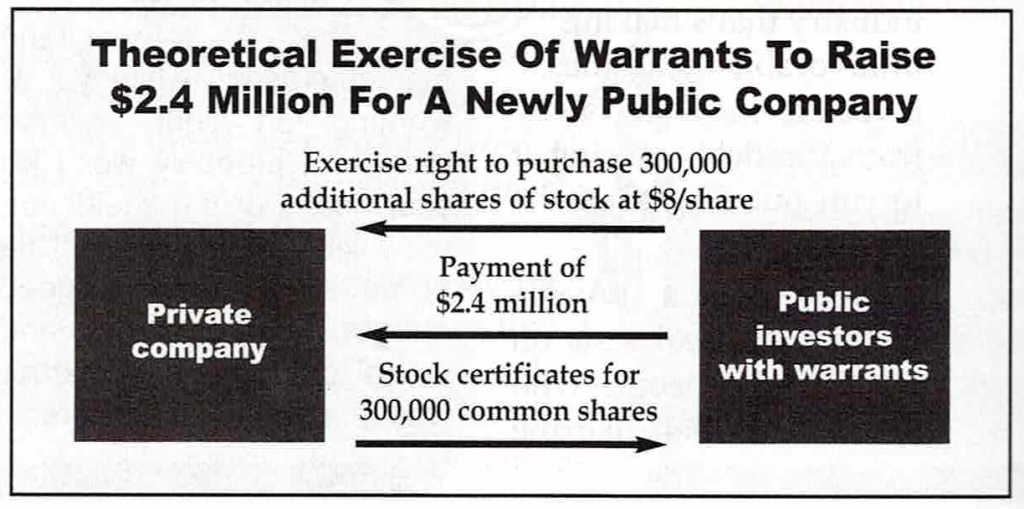
- Exercise of warrants. Warrants are options, which give the holder the right to purchase additional shares in a company at predetermined prices. When many shareholders with warrants, which a public company can easily issue, exercise their option to purchase additional shares, the company receives an infusion of capital as shown above.
- Private Offerings. Many, many more investors will step up to the plate for a private offering of shares, once they know there is some sort of mechanism in place for them to resell their shares if the company succeeds. Most investors realize that even a successful company may not be able to go public if market conditions are off. But a company that is already public . . . that’s a different story. If it succeeds, the likelihood of developing a market for its common stock that accurately values the company and allows the investor to sell their shares is much much better.
THE DRAWBACKS OF A REVERSE MERGER
Reverse mergers aren’t for everyone, however. There are several drawbacks to this financing technique. Among the disadvantages:
• Image. Reverse mergers have accumulated their share of controversy over the years. There are several reasons for this. First, most reverse mergers start with dormant public companies. Most of the time, they fell into dormancy because of failure in their line of business. As a result, there may be an angry group of shareholders somewhere in the deal. Second, the chances of some irregularity occurring in the trading, most likely unknown to the company, are high with reverse mergers. The reason is most reverse transactions initially trade on the Pink Sheets or the Bulletin Board, the least regulated tiers of the market.
• Unknown shareholders. At the end of the day, the private company which acquires a public one is left with a shareholder base it does not know and has no previous interaction with. These shareholders can place significant downward pressure on a company’s stock by continually selling their shares as a new trading market develops. Also, creditors, or other parties which suffered from the failure of the predecessor company, can start to come out of the woodwork, and make claims against the new management.
• Indirect route to capital. Reverse mergers represent a way to make a company financeable not necessarily finance it per se. Though they are theoretically quick and easy, like any securities transaction, reverse mergers contain enough wrinkles to make the process drawn out and lengthy. But in most instances, just consummating the reverse merger transaction is only the halfway point in a company’s pilgrimage to growth capital. When it’s done, the company still has to go out and beat the bushes for the cash they need.
| Shop Talk: The controlling shareholders of a shell corporation will most likely insist on owning a small stake in the deal going forward. This “trailing interest” is simply a cost of doing business. |
• Difficult to become a real public company. Despite the fact that an exciting private company has taken over control of a dormant public company doesn’t mean other investors will sit up and take notice. In fact, the only investors who tend to care about the change in control are the ones who invested in the original company. Oftentimes, their interest is mercenary: they simply want to know when the new company will succeed to the point where they can get their money back.
As a result of this relative obscurity, most reverse mergers find their stock doesn’t trade much. Moreover, company executives and principals find they have a hard time attracting investors to their stock to create the kind of trading and liquidity which is the benchmark of a real public company.
| THEORY INTO PRACTICE: THE MECHANICS OF A REVERSE MERGER In the diagram below, the hypothetical public company has 1 million common shares outstanding prior to any sort of transaction with a private company. Of these 1 million shares, 500,000 are owned by public investors, and 500,000 are owned by the person or persons who control the public company. Once a deal is struck for the private company to acquire the public one, here’s how it might be consummated in a three-step process: 1. The public company issues 9 million shares of common stock to the person or persons who own the private company. Now, what is the ownership structure of the public company? There are now 10 million shares outstanding. Of these, 9 million or 90% of the company is held by the owner of the private company. Another 500,000 shares, or 5% ownership of the company, are held by the person or person who controlled the public company. And the public investors, hold the other 500,000 shares or 5% of the company. Note that prior to the merger, the public-owned 50% of the public company, but after the merger, they owned just 5%. 2. The 9 million shares of common stock are usually issued to the shareholders of the private company in exchange for something. In most reverse merger transactions, the private company: a) contributes all of its assets to the public company; b) issues shares of its own to the public company, or c) buys the shares outright from the public company at a nominal price. 3. The public company then changes its name, usually to the name used by the private company, to reflect the change in its business. |

STRATEGIES & NEXT STEPS FOR A REVERSE MERGER
If a reverse merger still sounds like a good idea to you, here are the steps you need to take.
• Find a shell company. You can find a shell company through the usual suspects. As a first stop, ask an attorney. Every metropolitan area has a law firm with a securities practice. Many times these firms have a dormant public company literally sitting on one of the partner’s bookshelves.
Another alternative is an accountant. People who control shell companies tend to keep the financial statements, such as they are, up to date. This brings accountants into the loop. Like the attorneys, they know where the bodies are too.
Another source is financing consultants. In fact, many financing consultants actually have a couple of shell corporations, and upon request, can manufacture a clean public shell. Made-to-order shells, without the baggage of a business failure in its background, can sometimes be the way to go.
But, there’s often a cost involved. That is, you will most likely end up with the financing consultants as minority shareholders in the new company holding somewhere between 2 and 5 percent. However, in almost any reverse merger transaction, the principals of the shell company keep a small equity position in the company going forward. Therefore this surrender of equity is simply a cost of doing business.
• Devise your financing strategy. As mentioned several times already in this chapter, a reverse merger is an indirect route to raising capital. Entrepreneurs must consider first how additional capital will be raised after the deal is done.
As mentioned above, a public company can issue and exercise warrants. Some public shell companies already have warrants issued and outstanding which have the underlying common stock shares registered with the Securities and Exchange Commission. This is much easier, and much more valuable to a company that wants to raise capital with warrants. If the newly public company has to create and issue warrants, the road to getting them exercised will be trickier, but still possible. In short, to exercise warrants where the underlying common shares are not registered, the exercise will require the assistance of a brokerage firm, and will have to occur in a state where there is no registration requirement for issuance of shares of $1 million.
| Don’t Forget: If you need all the bells and whistles of a true public company, you can spend as much time and money on the back end of reverse merger as you would on the front end of a conventional initial public offering. |
If you are going the private offering, i.e., an offering sold to select individuals rather than through a sale directly to the public at large, then the deal must be carefully structured. Specifically, the amount of stock owned by investors that the new owners do not know, and cannot influence — must be diminished so that a stable quote can be established. Usually, this is done by reducing the percentage of the total number of shares which these investors own (See Sidebar Above, The Mechanics of a Reverse Merger) By doing so, the private investors can be offered stock at a discount to the market price as an added incentive.
For example, if the stock is $7.00, the private offering offers investors common stock at $5.00. This incentive evaporates when sell orders flood the market, and the market price of the stock drops to $5.00.
Of course, a smart investor knows they can’t simply load up on $5.00 stock in a private placement and turn around and sell it out on the public market at $7.00. There simply aren’t that many buyers to support that kind of selling. But the point is, it’s much easier to sell common stock to investors at $5.00 in a private offering when the market price is $7.00 as opposed to trying to sell common stock privately at $5.00 what the market price is $4.00.
• Clean up your act. Unfortunately, there’s a stigma attached to reverse mergers. LVA-Vision’s Stephens, who used the technique to brilliant effect, said that although it worked for his company, “there’s definitely, another side to these deals. If it wasn’t for my longstanding reputation in the medical community, our deal might have been perceived differently.” Largely, the bad rap stems from the fact that reverse mergers are not understood says Stephens.
Accordingly, entrepreneurs contemplating such a transaction, can and should take steps to elevate the profile of their “new” company. Specifically:
1. Hire a national accounting firm. One of the reasons the “big five” fees are high, is because they inspire a lot of comfort among investors, traders, and regulators. If you saved a lot on fees at the front end, this might be worth investing in on the back end.
2. Hire a prestigious law firm. It’s almost a certainty that the attorney who helps you with your reverse merger transaction, if he or she is an expert in the process, will not be with a prestigious downtown law firm. And though you may be reluctant to switch from a competent and trusted counselor after the deal is over, for the sake of the company and its credibility, it might be a good idea. When deciding whether or not to get involved in your offering, many investors and brokers will judge your firm by the company it keeps. An unknown law firm makes a neutral to a negative impression. But a well-known and powerful law firm sends an unmistakable message.
• Start with a clean shell. As mentioned, there are many shells which are created for the express purpose of merging with a private company. These shells have no predecessor entities, and as a result, little baggage in the way of a business failure or other skeletons in the closets.
• Check your greed. The great rallying cry of the 1980s popularized by Hollywood’s oily takeover artist, Gordon Gekko, “Greed is good,” doesn’t quite apply with a reverse merger. It’s possible to structure a reverse merger so that at the end of the day, the public owns 2% of the company, and the remaining 98% is controlled by the owners of the private company which acquired the shell. Unfortunately, there’s almost no incentive for any other investors to get involved if the only people who truly benefit are the insiders. The lesson is, if you are going to get the public involved with the intention of engaging in a truly symbiotic relationship, you’ve simply got to leave some value on the table.
In many ways, the reputation of reverse mergers is similar to the notoriety which junk bonds had during the 1980s. Junk was used by corporate raiders to buy companies and break them up. But junk bonds also nurtured an entire generation of exciting growth companies and made material and profound impact on the economy in terms of wealth and employment.
Remember, reverse mergers are simply a technique. The ultimate goodness or badness of the deal depends on how wisely it is deployed.
| Taking Action: Start calling attorneys and accountants and ask them if they are aware of a clean shell company. You should locate something in less than 10 calls. |
Royalty Financing
| Definition or Explanation: Royalty financing is an advance against future product or service sales. The advance is paid back by diverting a percentage of the product or service sales back to the investor who issued the advance. Appropriate For: Established companies that have a product or service or emerging companies about to launch a product with high gross and net margins. Also companies with elastic pricing, i.e. the ability to raise prices without any impact on sales. In addition, royalty financing is most appropriate for companies which experience a quick cause and effect between marketing activity and sales increases. Supply: Substantial. Royalty financing can appeal to investors who typically do not make investments in private companies. In addition, angel investors, venture capitalists, and even state, city, or regional economic development agencies can be sold on the concept of royalty financing. Best Use: Financing intensive sales and marketing activities. Cost: Inexpensive for companies with high margin products or services. Ease of Acquisition: Relatively easy because the technique appeals to a wide variety of investors. In addition, because royalty financing is essentially a loan, it generally does not provoke state and federal securities laws. Range of Funds Typically Available: $50,000 to $1 million |
ROYALTY FINANCING: THE SECRET WEAPON
Many companies still in their formative stages face a difficult dilemma when looking for equity capital. Equity investors, whether they are angels or venture capitalists, often demand a big piece of the company because of all the risk they are incurring. The dilemma is compounded by the fear that, if the company gives up 30%, 40%, or even 50% of the company on the first round of outside financing, there’ll be nothing but a grubstake left by the time the company goes public.
Enter royalty financing which eliminates the dilemmas of equity financing by removing them from the picture altogether, according to Peter Moore, founder of Banking Dynamics, a consulting firm in Portland, ME, which helps companies raise capital, and a proponent of the royalty financing technique. “Instead of selling equity,” says Moore, “a company simply pledges a piece of its future sales against an advance provide by the investors.”
| A Good Deal: Royalty financing is a good deal for investors who typically do not invest in early stage companies because they are able to taste the fruits of their investment almost immediately, and if the company prospers, every month or quarter thereafter. |
A CASE IN POINT
Here’s how Moore structured financing to help a software company turbocharge its sales.
Rather than angel investors, Moore approached the Greater Portland Building Fund, and Coastal Enterprises, Inc., quasi-public economic development organizations charged with developing business in the state.
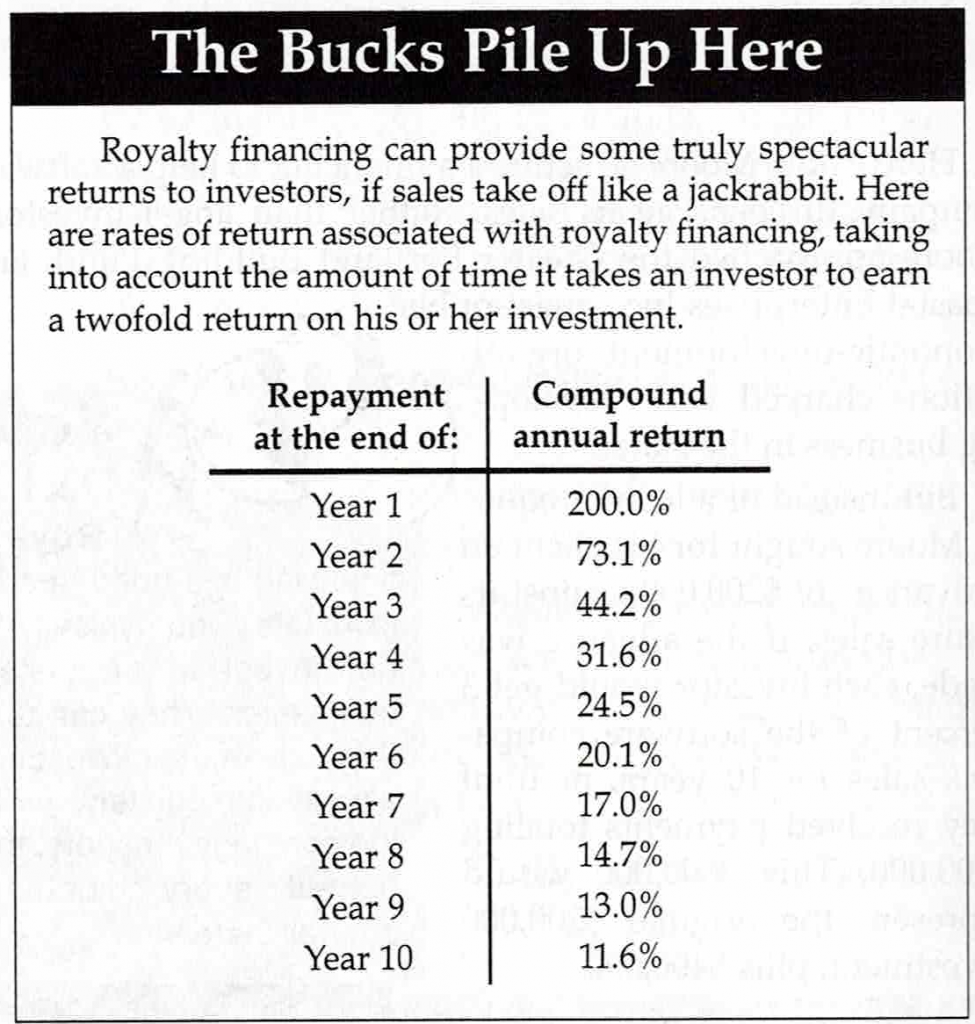
But instead of a loan or equity, Moore sought an “advance” of $200,000 for his client against its future sales. If the advance was made, the investors would each get 3% of the software company’s sales for 10 years, or until they received payments totaling $600,000. This $600,000 would represent the original $200,000 investment, plus $400,000 more.
At the broadest level, in order for the investors to get the agreed-upon $600,000 within the maximum allowable time frame, the software company would have to generate total sales of $20 million over 10 years. Although the software company had less than $1 million in sales at the time, it had over the course of its three-year life, double sales each year. “This was a big selling point,” says Moore. Moreover, he says that investors were comforted by the fact that the company’s software program, which helps companies manage hazardous waste streams, meant there were 300,000 potential customers.
The deal was structured so that the time frame was flexible — up to 10 years to make repayment — but the return — $600,000 — was not. Because of this, the return which the investors could earn was variable as well, and ranged from pretty good to exceptional. Specifically, if the software com pany repaid the advance in 10 years the investors would earn a compound annual return of 11.6% on their investment. If however, the company’s sales mushroomed, and $600,000 was paid to the investors in five years, their compound annual return mushroomed also to 24.5% — a rate which even an institutional venture capitalist would have to admire.
It took Moore and his client about four months to hammer out all the details of the deal. One of the key terms that Moore negotiated for was a delay in the commencement of royalty payments. Specifically, royalties did not start to accrue until 90 days after the deal closed. In addition, the actual royalty payments did not have to be paid until 60 days after [italicize after] the revenues were recognized. “All in all, there were five months from the time the company received the financing, and when the first payment was due. This gave them the time they needed to put the capital to work and start producing sales.”
| Don’t Forget: The initial advance from the investor to the company is a loan, not an equity investment, and as a result, does not in general provoke securities laws. |
IT’S A GOOD THING
Royalty financing is extremely flexible and can be structured in a myriad of ways. But regardless of the final structure, the technique delivers a host of advantages that entrepreneurs should carefully consider before rushing to sell equity in their companies.
• Attractive to Individual Investors. Generally speaking, it’s difficult for most individual investors to get involved in financing private companies. Many times, they don’t have enough capital to make a difference. Many times individual investors don’t have the minimum net worth requirement established by state securities regulators. But perhaps one of the biggest barriers is that buying straight equity general only provides a return if the company gets acquired or goes public, two very big ifs. Moore speculates that a monthly or quarterly return — which happens as long as sales occur — would be more preferable to individual investors than the total absence of a yield and zero liquidity that is typical of early-stage venture deals.
| Shop Talk: The concept of ‘revenue recognition’ takes on greater significance within the context of a royalty financing because it defines the payments to the investor. Should revenue be recognized when the customer agrees to purchase the product or when they pay for it or perhaps after a 30 day return period has elapsed? |
• Bypasses Securities Laws. Because the royalty advance is, at the end of the day a loan, it does not, in plain vanilla form, provoke any state or federal securities laws. Most equity financing, where companies sell shares to individual investors requires complex filings that mean significant legal and accounting fees.
• Increases Future Financing Options. A company funded by royalty payments increases its financeability down the road. If the funds do in fact ramp up sales, the company becomes a more attractive candidate for additional financing. In addition, sometimes the presence of one kind of equity investor precludes the participation of other kinds. For instance, a company financed with institutional venture capital funds cannot, in most cases, ever go back to raising money from individuals. But by “saving” itself for outside investors to a later round of financing, a company keeps its options wide open.
• Preservation of Equity. The royalty structure preserves the equity positions of the founders. Remember, there are only 100 percentage points to go around, and they begin to disappear with alarming ease once a company begins to raise outside capital. In addition, when founders are able to hold on to a significant portion of the ownership they may be more incentivized to make it successful, than entrepreneurs who have given away most of the store.
NOT FOR EVERYONE
It may sound as if royalty financing is a panacea. Unfortunately, it’s not. There are several instances where royalty financing will not work.
• Thin Margins Are A Problem. If a company’s gross margin (sales less cost of goods sold) is just 10%, and 6 percent goes to royalty payments, then the remaining 4 percent doesn’t leave much room for making any money. In the above example, the software company which Moore financed had a gross margin of 90%. With margins this wide, it could comfortably give up 6 percent of the sale.
• Competitive Pricing. Royalty financing works best for companies whose pricing is fairly elastic. If you can raise your prices to cover the cost of the financing, the marketing of the product, and not lose any customers, you are a better candidate than a company where customers are price sensitive.
• Lengthy Sales Cycles. Royalty financing won’t work for companies that do not see a rather immediate cause and effect between marketing efforts and sales. “You’ve got to be able to turn on sales like a spigot,” says consultant Moore. Otherwise, one of the primary benefits for which investors are in the deal — namely a monthly royalty check — becomes seriously compromised. The one thing a growing company doesn’t need are unhappy investors.
This limitation goes even deeper. Royalty financing is not appropriate for financing product development. After all, making something new is tricky. Success may be elusive, or — and how often does this happen? — it takes much longer to develop the product or service than originally anticipated.
• Good Marketing Skills. Obviously, just having a product can’t win the day. For companies to effectively use this technique, they’ve got to be able to sell [italicize sell] and market [italicize market] their wares. “Obviously,” says Moore, “you have to be able to inspire confidence among investors that you have the skills and experience that will move products or services off the shelf frequently and quickly.”
| Taking Action: To get a primer on royalty financing, send a self addressed stamped envelope to Mr. Peter Moore, Banking Dynamics, 97 A Exchange Street, Portland, ME 04101, 207-772-2221. |
Community Development Financial Institutions
| Definition or Explanation: Community Development Financial Institutions (CDFIs) provide primarily loan financing to businesses in areas seeking economic development. CDFIs make loans that are generally “unbankable” by traditional industry standards. Appropriate For: Start-up to established companies that can demonstrate the ability to repay a loan, but whose loan proposal is unbankable because of past credit problems, size of the loan request, limited equity from founders, or limited collateral. Supply: Good. There are hundreds of CDFI’s in urban, rural, and reservation-based communities with billions of dollars to lend. Unfortunately, despite their numbers, CDFI’s can sometimes be difficult to track down. Best Use: To start a new business or to expand an established one. But also, where the application of the proceeds can create a second bottom line in the form of community job creation, the introduction or preservation of a service that is vital to a community, or stabilizing a community in decline. Cost: Relatively inexpensive. Most CDFI loans are priced according to risk, as opposed to the cost of funds. Since CDFI loans tend to be riskier than bank loans they tend to cost more as well. Typical pricing may be from a half to three percentage points higher than conventional loan rates. Ease of Acquisition: Easier than commercial lenders but challenging, since for loans, a company must still undergo the scrutiny of traditional credit analysis. The challenge of securing CDFI financing is sometimes compounded by the relatively narrow focus and agenda which these institutions may maintain. Range of Funds Typically Available: $25,000 to $500,000. |
THE POWER OF THE PEOPLE
The idea behind a Community Development Financial Institution (CDFI) is simple and powerful. In a nutshell, this idea is that a community will make viable loans to businesses that can help it grow and prosper.
That was certainly the case with two unlikely entrepreneurs from the Northwest. Sawmill managers Mike Brine and Dave Miles always had the itch to work for their own company instead of someone else’s. As a result, when the opportunity arose to take control of a closed down mill, and call it their own, the two didn’t waste any time looking into it.
The only problem is when opportunity knocks, it usually wants money. In the case of the two rough-hewn entrepreneurs, the opportunity required a capital commitment of $100,000.
There were plenty of risks. First, the business, despite its previous heritage, would be a pure start-up Second, operating a sawmill was a risky business. Mills had closed by the score throughout the Pacific northwest. By almost any yardstick, the deal which Brine and Miles had in mind was not bankable by any stretch of the imagination. But the Cascadia Revolving Loan Fund, a community development financial institution in Seattle had a different perspective.
| A Good Deal: Although CDFI financing is generally more expensive than conventional loan financing, it is often still a good deal, because the alternative is often no financing at all. |
According to loan officer Josh Drake, Cascadia, true to the credo of a CDFI saw its way through the risks and came through with the $100,000 financing package. The deal consisted of a $25,000 five-year term loan, and a $75,000 equity investment. Drake says that the equity investment, though unusual for a community loan development fund by historical standards, is a growing trend, and a positive one, since equity investments do not carry the regular interest payments which can be so crippling to a new enterprise.
Cascadia and the surrounding community reaped significant rewards on its investment. The lumber company the two entrepreneurs started about 150 miles southwest of Seattle, turned in a profitable performance during its first full year in business, and generated $5 million in revenues. In addition, the company’s payroll swelled from the initial two entrepreneurs with a dream to more than 50 hard-working saw men in the great Northwest.
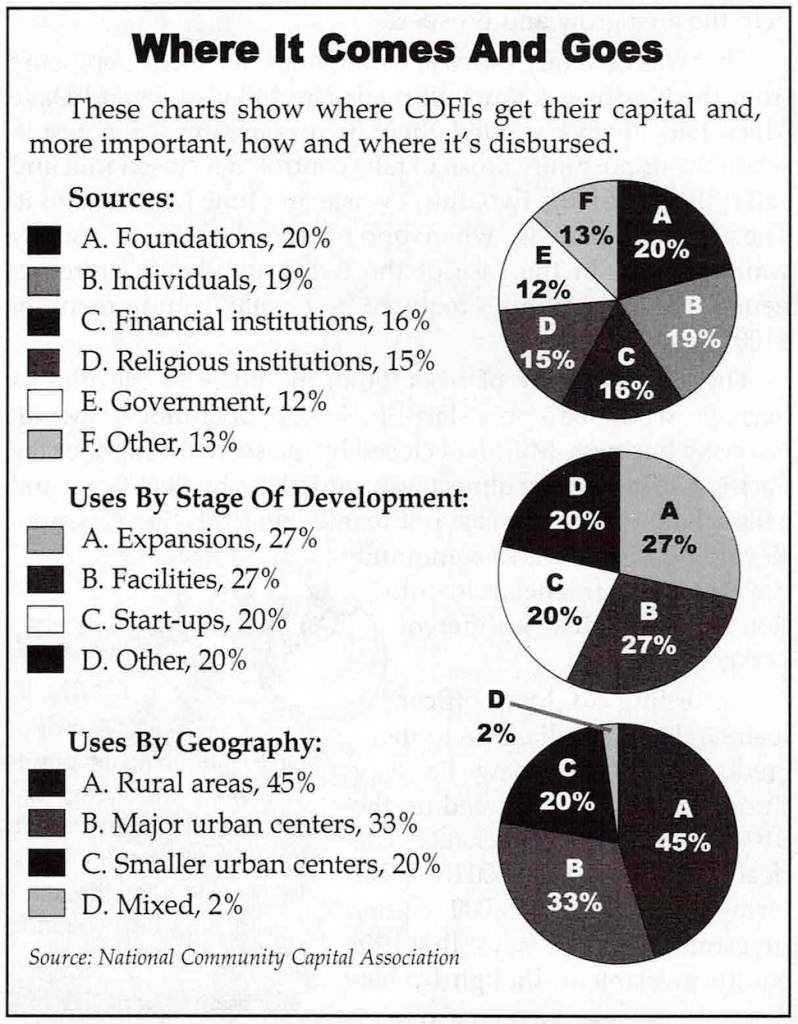
REAL BUSINESSES, PLEASE
Don’t be fooled into thinking that helping a community develop economically means the CDFIs will back any local entrepreneur with a gleam in his or her eye for a new business.
| Don’t Forget: Community Development Financial Institutions offer loans, not grants. As such, they are looking to finance companies which demonstrate an ability to pay them back. |
Quite the contrary. The way most loan officers at CDFI’s see it, their capital is the dearest of all. Because without them, the surrounding communities wouldn’t have access to hardly any (and in some cases, not any) capital. As a result, they can’t pick losers. They need their capital back so they can recycle it again into the community and jump-start the process of economic development.
Testimony to the loan standards of CDFI’s is their national loan loss rates. These rates measure the percentage of their loans lost to failure and nonperformance. According to the National Community Capital Association, the national loan loss rate is about 1.4%, a figure which rivals, and in some instances actually beats [italicize beats] the performance of traditional commercial lenders.
| Shop Talk: Commercial lenders tend to think of loans in terms of being “bankable” or “unbankable”. Your loan proposal is not bankable if you cannot demonstrate a viable source of repayment. |
However, according to Mark Pinsky, executive director of the National Community Capital Association, a trade group of CDFIs, lenders at CDFIs tend to take more risk because they will look more closely at the present facts and circumstances rather than historical patterns. “More and more banks that make small business loans are using credit scoring systems,” he says. “These systems work great, but since they are numerically driven, a lot of companies get weeded out, that might otherwise be viable credits.”
CDFIs he says are different in that, “we deal with the entrepreneur, and with the specific opportunity at hand, not necessarily the fact that there is a blemish on his or her personal credit report.”
| EVOLUTION IN THE AIR The National Community Capital Association’s Pinsky says that there is a growing trend among CDFIs to provide equity financing as well as loan financing. In fact, the National Community Capital Association recently changed its name from the National Association of Community Development Loan Funds, because the membership, and the kinds of financings they were becoming involved with were changing. “The fact is,” says Pinsky, “our mission is more than to create CDFIs, we are really striving to create institutions which can use capital to create stronger communities.” He adds that as part of this mission, many members readily recognize that debt financings do not address the needs of many small businesses because their cashflow is not stable enough to support regular interest payments. In short, debt, even when they can get it can prove debilitating. “As a result, many of our members are now putting equity into companies which generally do not attract the interest of traditional equity investors and venture capitalists.” |
5 STEPS TO CDFI FINANCING
- Contact the CDFI and schedule an appointment. Not only are they willing to discuss your loan proposal, but many CDFI’s also assist companies in getting loan financing from other institutions as well.
- Be ready to demonstrate your “second bottom line.” Specifically, how will the loan result in job creation, the introduction of an important service in the community, or how will it help stabilize the local economy or community? For instance Pinsky, recalls an urban neighborhood that did not have a Laundromat. It was a Latino community and many of the families did laundry every day. With the closest Laundromat 20 blocks away it took all day. But then a couple of the residents got together to open a new Laundromat in the neighborhood, which was funded by a CDFI. The new facility, says Pinsky, spawned a small bodega, an eating establishment, and a newsstand. “In essence,” he says “this one small business helped stabilize the economy of the entire neighborhood.”
- Show you are committed to the community, and that your long-range plans are to stay there, not grow up and move on.
- Set aside ample time. The CDFI loan officer will tend to spend more time with you than a traditional commercial lender. Give them their due, because it might result in the creative solution which will deliver your financing.
- Be ready to commit some of your own funds. If possible set aside some of your personal capital to put into the business as an incentive for the CDFI to make a commitment. Nothing gives a lender comfort more than a founder putting in everything he or she can.
| Taking Action: To find out if there is a CDFI in your area, you can request a list from the National Community Capital Association (NCCA). Send a self-addressed stamped envelope to the National Community Capital Association, 924 Cherry Street, Philadelphia, PA, 19107. 215-923-4754. |
Asset-Based Loan
| Definition or Explanation: Loans, generally from commercial finance companies (as opposed to banks) which are frequently offered on a revolving basis and collateralized by a company’s assets, specifically accounts receivable and inventory. Appropriate For: Companies that may be rapidly growing, highly leveraged, in the midst of a turnaround, or undercapitalized. In addition, asset-based financing works only for companies with proven accounts receivable, and a demonstrated track record of turning over their inventory several times each year. Supply: Overall, the supply of asset-based financing is vast. There is a large number of commercial finance companies, as well as a number of banks, which have massive pools of capital to lend to businesses. However, for smaller asset base loans, those of $500,000 or less, the market is considerably smaller. Most asset-based lenders would prefer to make larger loans because the costs to monitor an asset-based loan are generally the same whether it is large or small. Best Use: Financing rapid growth in the absence of sufficient equity capital to fund receivables and inventory. In addition, asset-based loans can be used to finance acquisitions as well. Cost: More expensive than bank financing, since asset-based lenders generally have higher costs than bankers. Still, pricing is competitive among asset-based lenders. Small asset-based loans can get pricey though, running between 12% and 28%. Ease of Acquisition: Comparatively easy if your company has good financial statements, good reporting systems, inventory that is not exotic, and finally, customers who have a track record of paying their bills. If you do not have any of these things, your path to an asset-based loan will be challenging. Range of Funds Typically Available: $100,000 and up |
ASSET BASED LENDING – WHAT IS IT?
Conceptually, asset-based loans are easy to understand, according to William Barnett, a partner with the law firm of Herrick, Feinstein, New York City, who specializes in asset-based lending. Specifically, he says, “Asset-based lending is formula lending based on the liquidation value of accounts receivable and inventory.”
While term lenders certainly consider the value of these assets when making a loan, they are secondary. For the most part, when a banker makes a term loan, he or she is looking at the cash flow [italicize cash flow] of the enterprise and trying to determine whether or not it is sufficient to service the debt, and whether or not it can be sustained for the term of the loan.
Asset-based lenders, on the other hand, do not focus on this. They look at two asset classes: accounts receivable and inventory. With knowledge of these assets, the asset-based lender will make a short-term loan. Although this short-term loan gets paid off as accounts receivable and inventory liquidate, for growing businesses, more accounts receivable and more inventory are being created all the time. As a result, an asset-based loan has a revolving quality to it, and may remain on a company’s books for quite some time. This can be a good thing because it gives a company time to catch its breath. But it can also work against a company because, an asset-based loan may not get renewed, and must then be paid back before a company is prepared to do so.
| Shop Talk: When a lender takes a ‘security interest’ in an asset, it means they are granted possession of and ownership in the assets in the event of a default. The security interest that lenders are able to take on inventory and accounts receivable is the basis of their collateral, and as a result the underpinning of the loan. |
An asset-based lender’s emphasis on assets rather than cash flows makes a significant impact on the relationship between lender and borrower according to Barnett. First, the asset-based lender is taking a security position in the underlying assets and views liquidation of them as a viable means of recovering the loan principal. Second, because the asset-based lender is lending against assets that can fluctuate in value rapidly, he or he will monitor these assets more intensively. “It’s not uncommon,” says Barnnett, “for asset-based lenders to look at the inventory or accounts receivable once a month, sometimes even more frequently.” Conventional lenders making term loans, on the other hand, might review financial data once a quarter, and never look at inventory once the initial loan is made.
ESTIMATING YOUR BORROWING CAPACITY
Your borrowing capacity for an asset based loan rests on what your assets will support, and not unrelated, the maximum line a lender is willing to grant you.
| THE FACTOR FACTOR A close relative of asset-based financing is factoring. The primary difference between asset-based lending and factoring is that the former is a loan against an asset, while the latter is the outright sale [italicize sale] of an asset. That’s right, when you factor in your accounts receivable, you sell to a third party your right to receive payment. Of course, if you sell the asset you receive payment, just not as much as you would receive if you waited until your customer maker their payment. A factor makes money by purchasing your $100 receivable for $87.50 and then receiving from your customer the full payment of $100. One of the drawbacks of factoring is that once you sell your accounts receivable, you lose control over how they are collected. A factor that collects very aggressively, might turn off your customers and damage the relationship you have built up with them. |
Barnett says that most asset-based lenders will lend 90% of “eligible” receivables, and 50% of “eligible” inventory. So, what’s meant by the word “eligible”?
Basically, just because you have an asset on the books doesn’t necessarily mean that a lender will advance you funds against it. “Asset-based lenders will deduct ineligible receivables such as those from mom and pop shops, or ones that are more than 45 days old, or ones from customers that have had a bad debt on prior receivables, or perhaps receivables due from customers overseas,” Barnett explains.
So on the receivables side, the equation looks like this:
Total Receivables – Ineligible Receivables = Net Eligible Receivables
and
Net Eligible Receivables x 0.90 = Total Borrowing Capacity From Receivables
The same concepts apply to inventory. That is, the inventory on hand needs to be adjusted by the lender. Specifically, ineligible components must be removed to estimate what constitutes the eligible portion. Ineligible inventory might include items that are over 180 days old, certain exotic goods that would be difficult to liquidate, and material that may have spoiled or been damaged.
Total Inventory – Ineligible Inventory = Net Eligible Inventory
and
Net Eligible Inventory x 0.50 = Total Borrowing Capacity From Inventory
Barnett says that adding the two sums together, and subtracting out any outstanding debt represents the total availability of what can be borrowed, as long as it does not exceed the total line available to the company which is spelled out in the agreement between the company and the borrower.
Why does inventory get such a low advance rate, just 50% of eligible inventory, while accounts receivable gets 90% of the eligible amount? Basically, says Timothy Gannon, senior vice president and chief lending officer of MTB Bank, a privately held New York City-based bank specializing domestically on asset-based loans, “the accounts receivable are self-liquidating, while the inventory is not. If a lender needs to liquidate in order to recover the loan, they will have to take possession of the inventory and sell it, which can be difficult, time-consuming and expensive.” By contrast, he says, the majority of accounts receivable will, over time, hopefully, 30 days of time, turn themselves into cash through payments from customers.
| VENDOR FINANCING Slightly further up, or further down the food chain, depending on your perspective, is another source of asset-based financing. Vendors. In fact, vendors already do offer financing by giving most of their customers 30 days to pay their invoices. The reason many businesses need asset-based financing to begin with is that their sales cycle is longer than their accounts payable cycle. After all, if you could purchase goods on 30-day terms, sell them and get paid within 15, who needs financing? Unfortunately, most sales cycles take longer. So before talking to a commercial finance company start with your vendors. There are two ways to do this. The first is simply not to pay their invoices until they are 90 days old. This gives you three months of financing, in some cases free. You’ll know this strategy is working if they don’t freeze shipments to you after your first invoice is over 60 days old. The second way is to simply ask your supplier if they will extend your payment terms. If this is offered in conjunction with a lien of the materials they sell you, the vendor might just bite. After all, even if they don’t have the cash from you, they have still booked the sale. If your vendor is under pressure to show sales growth quarter to quarter, or year to year, your sale, even if it takes 90 days to collect, is helpful to their cause. Another way to get a couple of extra days out of your vendor is to test their limits. For instance, if you pay your invoices in 30 days, pay them at 35 days for a few months. If there’s no complaint, then stretch them to 44 days. Why does this work? Because many accounts receivable collection systems flag payments that are older than 45 days. Therefore if 35 days isn’t a problem, then chances are, 45 days is the magic number you need to avoid in order to keep the vendor happy. |
ASSET BASED LOANS – HOW THEY WORK
The diagram below shows the cash flows of a typical asset based loan.
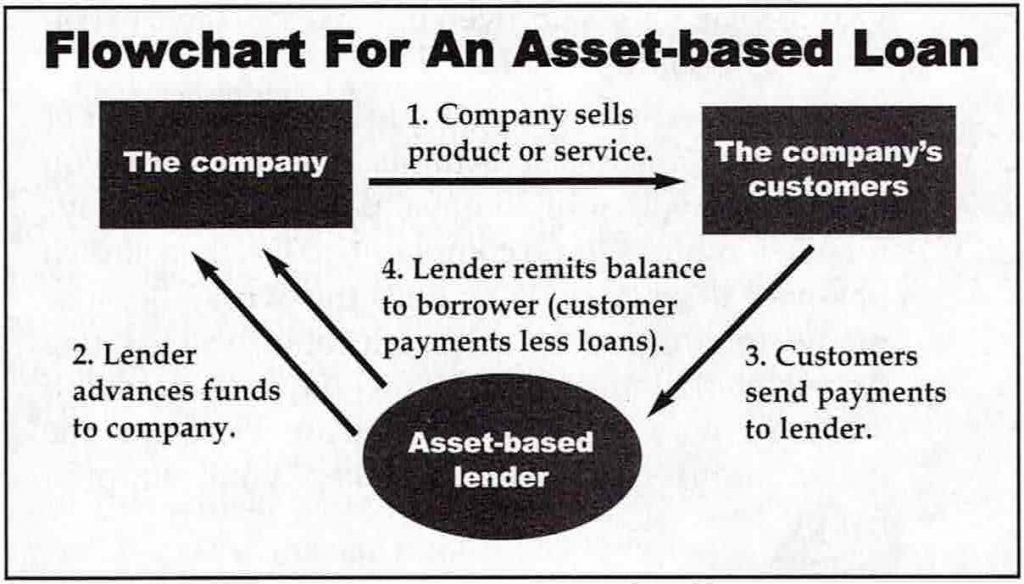
Step 1. The process starts with the company selling its product or service to customers. Unless it’s a cash business, or a business where customers pay for all of their purchases by credit card, a receivable is created. The receivable, really a debt to the company, will in most cases be repaid to the company in 10, 15, 30 or perhaps 45 days. This asset, in combination with inventory, which is not shown in the above diagram, starts the process.
Step 2. The lender makes a loan to the company based upon the value of the receivable. As discussed above, the lender will not advance 100% of the receivables, but 90% of the eligible receivables. The moment that the funds are advanced, the company starts paying interest, and the lender starts earning interest.
| Don’t Forget: Lenders want accounts receivable and inventory that can be turned into cash quickly. If you deal in exotic stuff, with exotic customers, which cannot be easily sold, asset-based lending may not be for you. |
Step 3. Pay close attention here. Note that with an asset-based loan, in most cases, the customers do not send their payments to the company who sold them the product or service, but instead directly to the finance company. Asset-based lending can be uncomfortable for some companies because a third party gains control of their cash flow.
This discomfort is warranted. Under such a scenario, certain events may turn out badly for the borrower. For instance, suppose a borrower has a large outstanding balance that is continuously revolving. Further, suppose that an entire group of the borrower’s customers experienced some sort of financial peril. Say they all sold products to a region of the world which experienced a financial meltdown. The lender, who monitors the assets very closely, and can begin to see the length of these customers’ receivables expanding, may take a “reserve” to protect itself against possible loan losses. Where might this reserve come from? From the company’s customer payments of course. Instead of remitting customer payments to the company, the lender will hang on to some of them to create this reserve against future loan losses. Suddenly, the company does not have the funds that it may have been counting on.
Step 4. The lender remits to the company invoices paid, less the principal on loans it has already advanced, less interest.
| A Good Deal: You cannot look at the cost of asset-based loans — which can carry annual interest rates of 24%, or more — in absolute terms. It appears far too expensive. Most experts counsel that smart borrowers treat the cost of an asset-based loan like another cost of doing business. If the loan’s expensive, but you can stay in business and make a profit, then that’s what you need to do. |
REQUIREMENTS AND SCENARIOS
MTB’s Gannon says that in order to successfully negotiate an asset-based deal, borrowers will need to come to the table with financial information that paints a positive picture and is also detailed and accurate, as well as a willingness to make the lender comfortable. Among the requirements he cites:
• The business must have a reasonable net worth, and long-term viability.
• Financial statements must be reviewed by a certified public accountant whom the lender deems acceptable.
• Borrowers must submit a year’s worth of monthly projections.
• The principals of the business must guarantee the loan, and the guarantee needs to be supported by personal financial statements.
• Keyman (or keywoman) life insurance may be required.
But Gannon says that even if you qualify for an asset-based loan, it might not be the way to go. “Asset-based loans are more expensive than bank lines of credit and are often much more intrusive on the borrower.
For instance, he says if you have a good guarantee, are profitable, and need to borrow say $500,000 twice a year for 60 days, go to a commercial bank. “That’s the cheapest, easiest way to go.”
Similarly, if you have a good guarantee, and need a line of credit to support inventory and receivables that can be “cleaned up” (i.e. paid back) within one year, there’s a good chance a bank will take a security interest in your inventory and receivables and offer a line of credit or a revolving line of credit. “This also will be cheaper than traditional asset-based loans.”
But he says, “If your guarantee is not that strong, you are not that profitable, your business is undercapitalized, you need working capital and there is no way you can pay off a line for perhaps two or three years,” says Gannon, “you present a problem for most banks even if despite the above circumstances, your business is a good one.” He says that the bank may take a flyer, but that in most instances such as this, a bank would refer you to a commercial finance company offering asset-based financing and that a commercial finance company will be your only source of salvation.
| Taking Action: Looking for an asset-based lender? One of the fastest and easiest ways to start your search is to visit the Web site for the Commercial Finance Association. You can enter the amount and type of capital you are looking for, and the site will give you the name, telephone number and contact persons at all the commercial finance companies that match your initial criteria. Visit www.cfa.com. |
SBA-Guaranteed Microloans
| Definition Or Explanation: The MicroLoan Program was developed by the Small Business Administration in 1992 to increase the availability of very small loans to small business borrowers. It achieved permanent status in 1997. The program utilizes nonprofit intermediaries to make loans to new and existing borrowers, and from 1993 through January 1998, accounts for 6,380 loans, totaling more than $65 million. Appropriate For: These funds may be used for working capital and for inventory, supplies, furniture, fixtures, machinery and equipment. Supply: MicroLoans are available from private, nonprofit intermediaries. Currently, the program is administered by 105 non-profit organizations serving their communities in 49 states plus Washington, D.C. and Puerto Rico. According to the SBA, there is a sufficient supply of funds due in part to a self-sustaining revolving fund. Best Use: For start-up companies with lower capital requirements and limited operating history. MicroLoan borrowers may benefit from the intermediary’s expertise in business. Cost: Negotiable with the intermediary, but rates tend to be higher than standard business loans. Most loans are collateralized by equipment, contracts, inventory or other property and require personal guarantees. Ease Of Acquisition: This is an especially good source of funds for businesses that have not borrowed from a bank before. And it provides a source of smaller loans which many banks are reluctant to service, especially as a business loan. One of the difficulties in obtaining MicroLoan funding, however, lies in the nonprofit intermediary distribution system. These intermediaries distribute funds in their own communities and/or regions and so, if one does not exist in your area, SBA MicroLoan financing may be difficult to get. If this is the case, however, there are other MicroLoan programs, often backed by state and local governments, that can offer an alternative. Range Of Funds Typically Available: Under $100 to a maximum of $25,000. Average loan size is $10,400, with an average loan maturity of 37 months. Maximum term for a loan is six years. |
SMALL IS BEAUTIFUL
Often, it’s the small loans that can be hardest to get, and most commercial banks are reluctant to make business loans under $10,000. Business owners who need less, or do not qualify for more, are left out in the cold unless they want to borrow the money personally. This latter option is often more expensive, typically ignores any business collateral, and perhaps most important, does nothing to advance the credit of the business.
“MicroLoans enable businesspeople to get small loans that are treated as business loans,” says Millard Owens, Director of Microlending for Self-Help, a nonprofit commercial development financial institution. “This is not to say that personal issues are not factored in, but that the strength of the business can help to offset some personal inadequacies.”
| A Good Deal: If your choice is between getting a personal loan and using the proceeds for your business, or getting a MicroLoan with the business as the borrower, take the MicroLoan. Even though you will have to personally guarantee the loan, it will help the business establish a sound credit rating. And as the bankers like to say “A good credit rating is your best asset!” |
For a new business, a new borrower, or a borrower with some blemishes in their credit history, the MicroLoan Program can provide an answer to the Catch 22 of lending–not being able to get money unless you have it. These loans have a range starting at just $100 and moving up to a maximum of $25,000, though different lenders may have their own minimums, so it’s wise to clarify this upfront when shopping for a loan. Starting small allows small businesses an excellent means of establishing business credit and improving their credit profile.
Some MicroLoan lenders focus extensive resources on offering training to their small business borrowers in management and other critical business skills, while others focus primarily on lending. Many MicroLoan borrowers can benefit from these services, and the availability of these services may be a consideration when choosing a MicroLoan lender.
MicroLoan lenders can often be more flexible than traditional lenders in their underwriting criteria, especially for smaller loans. They will look not only at credit history, collateral and debt history but tend to spend more time and attention on individual applicants. In addition, because of the nature of their small business clients, many MicroLoan lenders have already had experience with businesses that are considered to be risky by traditional lenders. With this experience, they are often more open to these types of ventures and more able to offer managerial assistance.
| Shop Talk: Every lender has so-called underwriting criteria, but what is it exactly? These criteria spell out the standards and guidelines the lender lives by. “Companies which have been in business at least two years with positive cash flow” would be two very simple underwriting criteria. When meeting with a lender, ask about their criteria to get some idea of how your company matches or mismatches their profile. |
Owens also suggests that potential borrowers–and other small businesses as well–check into other sources of technical and managerial assistance. Try local colleges and universities, chambers of commerce, and the SBA (see sidebar). Not only will you gain useful information, but this effort will help to demonstrate your seriousness and commitment to a prospective lender.
WHEN SMALL ISN’T BEAUTIFUL
MicroLoan lenders are not trying to compete with other lenders, and so you may find that their rates are higher than other loans. On the other hand, the rates are lower than credit cards and other vehicles often used to finance small amounts.
Convenient access to a MicroLoan lender may be an issue for some borrowers due to the limited number of SBA MicroLoan lenders, and their mandate to serve their local and regional economic development. To find out if there is an SBA MicroLoan lender in your region, call your district SBA office or go to www.sba.gov and check under lending and local resources. There are other types of non-SBA MicroLoan lending programs, generally backed by state or local governments. Ask your banker or contact state or local Chambers of Commerce or your State Department of Commerce for more information about these programs. Some universities also offer assistance to small businesses through the SBA, and it may be worth a call to the business department of a nearby university or college.
Another drawback of the MicroLoan program is the limited product line. Self-Help, for example, does not offer a credit line under the SBA program. Not all MicroLoan lenders offer a full range of loan products or even the full range of MicroLoan amounts. So, if you anticipate needing larger amounts of funds going forward, it may be worth considering establishing a relationship with a traditional lender.
| Help is on the Way The SBA provides a variety of business counseling and training services to current and prospective small business owners. You can locate where these services are offered near you simply by calling the nearest Small Business Administration district office or by visiting the SBA’s Web site at www.sba.gov. • The Service Corps of Retired Executives. The collective experience of SCORE counselors spans the full range of American enterprise. SCORE volunteers provide free management and technical assistance in all aspects of running a business — from writing a business plan to accounting and marketing and are available at SBA district offices, business information centers and some Small Business Development Centers. • Small Business Development Centers. SBDCs offer a broad spectrum of business information and guidance from assisting with market research to help in preparing business plans. In addition, SBDCs offer assistance in preparing loan applications. The program is a cooperative effort of the private sector; the educational community; and federal, state and local governments. • Business Information Centers. BICs provide the latest in access to high-tech hardware, software and telecommunications to help small businesses get started and grow strong. Supported by local SBA offices, BICs also offer expert counseling by SCORE volunteers. • One-Stop Capital Shops. OSCSs are the SBA’s contribution to the Empowerment Zones/Enterprise Communities Program, an interagency initiative that provides resources to economically distressed communities. The shops provide a full range of SBA lending and technical-assistance programs such as help with preparing financial statements, preparing loan applications, or credit counseling. |
THE MICROLOAN APPLICATION PROCESS
Self-Help is one of the nation’s most active SBA MicroLoan lenders, and Owens has been very involved in many of these loans. He says that the process of applying for the loan can be made easier by understanding what is involved and offers this explanation of what happens at their organization when a potential MicroLoan borrower initiates the loan process.
| Don’t Forget: Lenders speak the language of finance. You cannot converse with them without financial documentation. Even if you are a very tiny business seeking a very small loan, you must still have personal and business tax returns to get the process beyond the “nice to meet you” stage. |
During the first call, a Self-Help staff member will take the time to get some preliminary information, and in this initial conversation, the borrower will be asked a number of basic questions including:
- Is this a start-up or an existing business?
- How much money is needed and for what purpose are the funds intended?
- Who is included in the management team and what is their experience?
- What collateral is available?
- How much have you already invested, or are you willing to invest?
Following this preliminary information gathering call, applications are sent via mail, along with a form from which applicants are asked to develop a personal financial statement.
Business plans are not required at all levels according to Owens, but borrowers must have a complete understanding of their market, their capacity, and their competition. Previous financial statements are required for existing businesses, but in the case of start-ups, personal tax returns are often substituted.
Once this data is reviewed, Self-Help will contact the applicant by phone, usually within a few days. During this period, Self-Help will have a credit report to add to the information supplied by the applicant. Often, adds Owens, the application is not complete and additional information is required. Many times it is the tax returns that are among the missing. The best advice, especially if you’re in a hurry, is to make sure to supply all requested information and, almost as important, make it as clear as possible in terms of the presentation of the information. In other words, if the lender can’t read it, it may as well not be there.
| A Good Deal: Check out the SBA’s Women’s Business Center, a Web site for women who want to start or expand their businesses. There’s free online counseling and a world of information about business practices, management techniques, technology training, market research and SBA services. Go to www.on-linewbc.org. |
From there, if the loan request is small, that is $5,000 and less, the process can be completed in a few days. Larger amounts take longer–three to four weeks–because additional information is required.
In summary, the MicroLoan program can offer a cash and credit jump-start to small or start-up businesses. Unlike many of their counterparts, these lenders are comfortable with the needs, collateral, and experience level of small borrowers, and are flexible in their dealings with this important part of the economy.
| Taking Action: Raising money is about making connections with other people. After all, it’s somebody else that’s got what you need. And often it’s a random path that leads you to the gold at the end of the rainbow. Pick any one of the above technical resources, make an appointment, see a counselor or consultant, and ask them to point you in a direction, any direction. |
Equipment Leasing
| Definition or Explanation: Equipment leasing is basically a loan where the lender buys and owns equipment and then “rents” this equipment to a business at a flat monthly rate for a specified number of months. At the end of the lease the business may purchase the equipment for its fair market value (or a fixed or predetermined amount), continue leasing, lease new equipment or return the equipment. Appropriate For: Any businesses at any stage of development. For start-up businesses with no revenues, “small ticket” leases, those of $150,000 or less, are feasible on the personal credit of the founders or owners — if they are willing to make the monthly payments. Supply: Abundant. Of the billions of dollars individual and institutional investors pour into the capital markets each month, a good hunk finds their way to leasing companies that use these funds to purchase equipment on behalf of small businesses. With more and more money pouring into the markets, leasing companies are flush with capital, eager to do business, and respond to competition with lower monthly rates. Best Use: Financing equipment purchases. Also, leasing can finance the soft costs often associated with equipment purchases such as installation and training services. Cost: Lease financing is generally more expensive than bank financing, but in most instances, it is more easily obtained than bank financing. Ease of Acquisition: Easy for leases under $150,000. An application for a small ticket lease is generally no more complex than a credit card application. Leases for more than $150,000 will require detailed financial information from the business and the leasing company will conduct the same credit analysis which a conventional bank would. |
A CASE IN POINT
When Phil and Meg Kensey took over Royal Laundry, which provides laundry services to institutions, the company was breaking even on sales of approximately $500,000. With some focused marketing efforts, the potential which the couple saw in the business quickly materialized with customers such as Electronic Data Systems, American Airlines and a large hospital group. “Our customers,” recalls Phil Kensey, “were offering us lots of opportunities to grow with new services and a higher level of volume.”
To take advantage of this demand, the Kenseys needed new equipment and lots of it. The dry-cleaning machines, automated folders and high-speed irons which they needed totaled about $500,000.
Phil says he tried to get a bank loan but was summarily rejected by national, regional and local lending institutions. “Even though the business was almost 10 years old when we sought the loans, in the eyes of the bankers it was technically a start-up since we recently purchased it. None of them were willing to finance a company that was less than 2 years old.” And even if they found a bank, the Kensay’s personal guarantee, which would be required, wasn’t worth much. “We put everything we had into buying the business,” says Phil, “We were cash poor.”
Enter Jim Lahti, president of Affiliated Corporate Services, Inc., a Lewisville, Texas, equipment leasing company. Lahti took a real interest in what the Kenseys were trying to accomplish, and over the course of two years, structured approximately seven leases that got Royal Laundry the equipment it needed. With the added capacity and new services, annual sales at Royal mushroomed to $2.8 million.
| A Good Deal: When you take out a lease for equipment, the entire lease payment is deductible as an expense. When you take out a loan to purchase equipment, only the interest portion of your payment to the lender is deductible as an expense. |
ADVANTAGES OF LEASING
Equipment leasing is big business. In fact, it is the single largest source of financing for businesses, totaling more than $180 billion annually at last count. The dollar volume of equipment leases exceeds the annual dollar volume of commercial loans. It exceeds the dollars raised through the issuance of bonds or the sale of stock. Leasing is bigger than commercial mortgages. And perhaps best of all, because of the high volume of lease capital which is available, equipment lease financing is readily available for small businesses.
Here are some of the most important competitive advantages of lease financing:
• 100 percent financing. With leasing the lessor (i.e. the company which purchases, then rents the equipment), finances 100% of the cost of the equipment being purchased. In fact, lessors often finance some of the soft costs associated with the purchase of new equipment such as training and installation.
| A Good Deal: Leasing companies will also frequently finance the soft costs that come with equipment purchases such as training, installation fees, service contracts, and even consulting fees you may have paid to get help figuring out which piece of equipment was right for you. |
• Easy Application and Rapid Approval Times. Most applications for leases under $150,000 are a single page in length and approvals can occur within 24 hours.
• Tax treatment. In general, the tax implications of leasing can be quite complex and could be the subject of a book in itself. However, for small-ticket leases, which are in most instances are so-called capital leases, the tax treatment is very straightforward and very favorable. The business leasing the equipment writes off the entire monthly payment as an expense. Conversely, when a business takes out a loan to buy [italicize buy] equipment — i.e. places it on its books as an asset — the company can only deduct the interest portion of the payment, plus a depreciation expense.
• Flexible terms. Most leasing companies can structure the term of the lease to fit a certain monthly payment which the business owner is able or willing to make.
| LEASING BY THE NUMBER Companies of every size use leasing. Commercial airlines lease jets. Caterers lease tables, chairs and chafing dishes. So how do the professionals who serve these diverse businesses segment the market? Basically, the leasing business is segmented into three distinct markets. • Small Ticket Leases: $100,000 or less. • Middle Market Leases: $100,000 to $1 million. • Large Ticket Leases: $1 million and up. |
NOT A BANK
According to Jim Lahti, who is also the president of Oakland, CA-based trade group United Association of Equipment Leasing, the distinction between an equipment leasing company and a bank runs deep. “When the bank makes a loan, you have some discretion over the proceeds. And if you buy equipment with the loan, you own the equipment, depreciate it, and pay the bank back. But with a leasing company, we buy and own the equipment, and rent it to you. So one of the primary differences is ownership.”
Another big difference is orientation. “What makes the leasing company more adventurous than a conventional lender,” Lahti says, “is that we do not labor under the same federal regulations as a bank, and we do not have the same audit trails as a bank.” To underscore this difference, Lahti says that his firm will lend up to $75,000 on a so-called “app-only” basis. By this, he means that the loan underlying the lease can be approved on the basis of information provided in the lease application, which is generally no more complex than an ordinary credit card application. Lahti says there are leasing companies that will do deals up to $250,000 on an app-only basis.
Finally, whereas most banks are geared up for credit analysis — a detailed study of a businesses’ financial position, and assessment of its’ ability to repay a loan — leasing companies are not. Says Lahti, “We all take the path of least resistance and try to figure out ways to make loans even faster.”
| ADDING UP YOUR CREDIT SCORE Credit scoring streamlines the credit process because it looks at relatively few variables out of many which constitute a company’s full financial picture. Each variable is scored, and the credit decision-making is done either by computers or clerks. Oftentimes, the credit scoring models are adjusted over time to reflect a lender’s experience. As these models evolve, many lenders regard their credit scoring system to be proprietary and a trade secret. Below are the main criteria which are evaluated in a credit scoring system. Time in business Lessee’s industry Type of equipment Bank’s rating of lessee Trade creditor’s rating of lessee Personal credit bureau reports of the principals Landlord rating Quality of the vendor supplying equipment to be leased Structure of the lease New or used equipment Credit reports of outside reporting agencies Source: The Leasing Professional’s Handbook |
IMPROVING YOUR CHANCES OF GETTING A LEASE
One of the reasons a small ticket lease is comparatively easier to land than a traditional loan is the widespread use of credit scoring systems by leasing companies. Banks are starting to use credit scoring systems for business, though most still utilize credit analysis. Under the credit analysis model, businesses are analyzed for their ability to meet a monthly payment and to pay off a debt. This analysis is time-consuming and expensive. In fact, the same credit analysis which goes into a $2 million loan, is also applied to a $200,000 loan — a fact that makes applying for a small business loan difficult and time-consuming.
But under the credit scoring model, businesses are analyzed not so much on their ability to repay a loan, but on the probability [italicize probability] that they will repay a loan. In fact, says Lahti, for leases under $100,000, a leasing company may simply credit score the business owners’ personal credit and check trade and bank references to reach a decision.
And as a general rule, for leases more than $100,000 but less than $150,000, the leasing company will credit score the business, and its owners, and ask for a full set of financial statements. Overall, however, the application process is streamlined with the actual application still just a page long, in most cases. When leases get over $150,000, Lahti says that would-be lessors will face the same kind of scrutiny and analysis which they would face with almost any commercial lender.
| Don’t Forget: A lease can be a superior alternative to a term loan because the leasing company will finance 100% of the equipment, whereas a bank will most often require a sizeable down payment for any major asset purchases which they are financing. |
So, what are the red flags which appear in a credit score that might cause your would-be lease not to be approved?
• Personal credit problems. Past delinquencies, slow payments, or nonpayments will reduce your overall credit score.
• A high number of credit inquiries. If a lot of lending institutions are scoring your credit, it could be a sign that you have made too many credit applications and are carrying too much debt.
• Lengthy payments on trade credit. If you stretch out the payments to your vendors to 90 days, it will come home to roost when you fill out an equipment lease application.
• A high number of NSFs. If you continually write checks that are returned for nonsufficient funds, it will seriously undermine your credit score.
• Lawsuits and judgments. Never a good sign for a lender.
• Frequent change in banking institutions. “If you change banks often,” says Lahti, “you’re not doing yourself any favors.” Most lenders, he says, like to see at least two years of history with the same institution.
• Being a bad tenant. If your landlord thinks you’re a lousy tenant, it causes a lessor to think you will be a lousy lessee.
• Exotic equipment. The harder it is to resell whatever equipment you are leasing (which is what will happen if the whole deal goes south), the lower your score.
If your credit score comes up poorly, Lahti says that most leasing companies will take steps to make the deal doable. “In the trade, we call this structuring,” he says.
Popular “structuring” techniques include down payments on equipment, additional guarantors (i.e. other people or institutions which will pay off the lease if the original lessee runs into financial difficulty), and anteing up additional collateral in the form of real estate, publicly-traded stock, letters of credit and of course equipment a company already has on hand. “If you already have equipment on your floor, I can use it as additional collateral. In fact, if you need working capital, we can buy your equipment [for a lump sum] and lease it back to you.”
| Shop Talk: The “residual” is the value of the equipment at the end of the lease period. Oftentimes the lessee has the option to purchase the equipment for its residual value. P.S.: The “lessee” is the entity taking out the lease and the lessor is the entity granting the lease. |
SCORING THE LEASE
There are ways to gauge how expensive or cheap lease financing is. To do this, you must know the residual value of the equipment you are leasing. The residual value is the value of the equipment at the end lease, which the lessee would have to pay to purchase it. For instance, suppose you lease a $12,000 warehouse forklift for $300 per month for three years, and at the end of the lease, the value of the forklift is $4,000. If you buy the forklift for $4,000, your total cash outlay is $10,800 (36 payments x $300) plus $4,000 for a total of $14,800. Since the forklift cost just $12,000 new, the difference between the original price and the total cash outlay is the implied financing cost, in this case, $2,800.
If the residual was higher, say $5,000, and the payments remained the same, $300, the resulting financing costs, $3,800, would be much higher than in the previous scenario.
Lahti says that such analysis represents a good starting point for analyzing a lease, but that other factors must come into play as well. “The, flexibility to extend or modify a lease, search and documentation fees, speed of approval, the ease with which you can upgrade to new equipment, are all features that must be taken into account when weighing one lease against another.
| Don’t Forget: If you are leasing equipment, you don’t own it. Therefore you can make a case that the lessor pays for repairs and taxes. |
LET’S MAKE A DEAL
Finding an equipment leasing company is easy. Almost any equipment which a business could conceivably need offers a lease option. Though it’s not apparent at first glance, the company offering the lease financing is not the same one that is selling the equipment. What happens is that the company selling the equipment simply makes a direct referral to a leasing company with which it does business.
It’s a good idea to get a quote from the leasing firm which is referred by the company that wants to sell you the equipment. The quote should be competitive. After all, the company selling products wants to sell as much as possible, and they surely don’t win any points by referring a leasing company that gouges its customers. But it also pays to get another quote as well. Usually, the company selling the equipment has more than one leasing company on hand, or ask a friend or business associate.
As a final point, when looking for a leasing company you should understand whether or not you are talking to a broker — who simply structures deals, then gets them financed through any of the leasing companies he or she works with — or a leasing company which is actually putting its own funds on the line.
There’s nothing wrong with brokers. The situation is analogous to working with an independent insurance agent. He or she might have intimate knowledge of the marketplace, and knows where to go to get the kind of insurance, or lease which you need, and in theory, at least, generates savings in excess of his or her fees. But with brokers, as in many other walks of life, the same advice applies: Buyer beware.
| Taking Action: To find a leasing company, call or write the United Association of Equipment Leasing for a referral. The address is 520 Third Street, Suite 201, Oakland, CA 94607. 510-444-9235. |
Loan Guarantees from Individual Investors
| Definition or Explanation: A guarantee of payment that stands behind an early-stage company and enables it to take out a loan from a bank. Conceptually, private guarantees play the same role as a Small Business Administration loan guarantee. Appropriate For: Early-stage companies which within a year will turn the corner toward profitability, or commence product sales. The limited time frame stems from the fact that loan guarantees typically only last for a year, and at the end of that period, the company must be able to raise equity capital to pay off the original loan, or be able to successfully apply for and get a loan based upon its own fundamentals. Supply: Though this technique is uncommon, the supply is theoretically abundant. Specifically, any wealthy individual, i.e. angel investor willing to consider an equity investment, should also be willing to consider a loan guarantee as well. Best Use: For companies that can put the borrowed funds to use and show an immediate result either in profitable product sales, or the commercialization of a product or service concept. Loan guarantees work particularly well for very young companies, who would otherwise end up selling a majority equity stake in the business if forced to use equity capital. Cost: The fees and interest on a loan guarantee can be very expensive compared to a traditional loan. However, loan guarantees make it possible for an entrepreneur to raise capital without surrendering any control, which makes it cheap compared to most forms of equity financing. Ease of Acquisition: Loan guarantees are somewhat easier to negotiate than pure equity investments because the investor guaranteeing the loan never turns over any of his or her own funds unless of course, the company does not perform as projected. Range of Funds Typically Available: No upper or lower limit. |
WHY LOAN GUARANTEES WORK
Whether you’re are raising debt or equity capital, you have run into the same behavior: lenders and equity investors are reluctant to let go of their money. While the attitude is the same, the motivations are quite different.
The bank would simply love to lend you the money. After all, the only way it makes an above-average return is to lend out what depositors put into the bank. But, because a bank is lending other people’s money, it operates in what is known as an “abundance of caution” mode. That is banks, because of the way they are built, are only allowed to make loans in situations of absolute safety. When working with emerging growth companies there are few instances of absolute safety, hence the challenge of loan financing.
Equity investors would generally like to finance your company as well. But they too have problems. Mostly it’s the fact that emerging growth companies are not just risky, but illiquid. Once they swallow the risk, most equity investors are still reluctant to cut a check because they know that even if the company succeeds, it will be tough to get their money back. To do so, the company will generally have to go public or get bought out. And if the company only succeeds on a marginal basis, then their investment can remain trapped inside the company.
It’s because of these emotions and constraints that loan guarantees can work so well. Specifically, when an angel investor stands behind a loan and guarantees it on behalf of a company, he or she doesn’t have to shell out of their own capital, at least not initially. And with a guarantee in the picture, the loan is absolutely, positively, 100% safe, meaning that almost any bank in the continental United States can make the loan.
| Don’t Forget: The concept of a loan guarantee isn’t anything new. In fact, loan guarantees provide the underpinning of the Small Business Administration’s 7(a) loan guarantee program. However, when loan guarantees are practiced in the private sector they can be more flexible and deliver significant benefits to lenders, investors, and most importantly, entrepreneurs. |
According to Arthur Lipper III chairman of British Far East Holdings, Del Mar California, which provides and arranges financing as well as advisory services, “To get such a deal done, entrepreneurs will need three ingredients. These are two banks and one guarantor.” Lipper says that providing loan guarantees to high-octane growth companies is a very subjective undertaking and that there are lots of ways a deal might be structured. However, he says a typical one year loan for $1 million, might be put together as follows:
First, the investor purchases a letter of credit from his or her bank. This letter of credit will stipulate that the investor’s bank will pay the entrepreneur’s bank $1 million on a certain date one year in the future.
Lipper says that for the investor to get his or her bank to issue such a letter, it will charge 1% to 2% of the amount of funds being guaranteed — in this case $10,000 to $20,000 — as a fee. But also, because it’s a bank, and banks tend not to take risks, it will also require the investor to deposit $1 million in government securities or $2 million of marginal securities into the bank. (So-called ‘marginable’ securities are those which can be borrowed against, a determination which is made by the Federal Reserve.) These assets collateralize the letter of credit which the bank will issue.
Now, with a rock-solid letter of credit for $1 million protecting them, says Lipper, the entrepreneur’s bank will then lend the entrepreneur the $1 million he or she needs to grow the business.
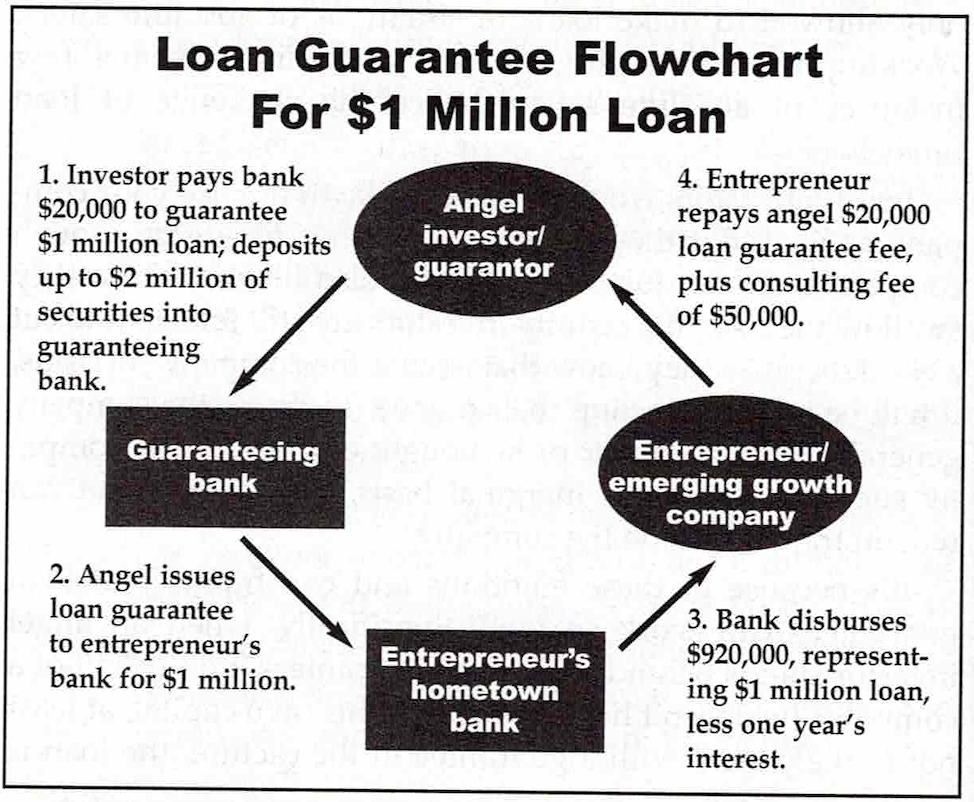
None of this comes cheaply. In fact, when you add it all up, it’s darn expensive financing. Here are some of the costs the entrepreneur would be expected to pay in such a transaction, according to Lipper.
| A Good Deal: If you get a loan from your bank which is guaranteed by a third party, negotiate for a prime interest rate, since by virtue of the guarantee, your bank is not incurring any risk. |
First, there’s the guarantee fee. Remember, the investor had to pay his or her bank a fee to get them to issue the letter of credit in addition [italicize in addition] to depositing funds into the bank. “The way the investor would tend to think,” says Lipper, “is that ‘it’s the entrepreneur’s [italicize entrepreneur’s] loan which is getting guaranteed, not mine’, therefore they should pay the fees.”
Next, Lipper says that he typically collects perhaps 5% of the loan as a fee for putting the deal together. For our hypothetical $1 million deal, that’s another $50,000.
Then there’s the interest to the bank. For deals such as this, banks typically charge the prime rate, plus 1% according to Lipper. “That’s absolutely outrageous for them to charge a premium like that,” he says, “since there is absolutely no risk to the bank whatsoever.” Moreover, he says, to avoid any possibility of default, the bank issuing the letter of credit will probably stipulate that the interest on the loan be taken out of the proceeds upfront, [italicize upfront] as shown in the above example.
The only good thing you can say about all these fees is that they generally don’t come out of your pocket per se. In most deals they come out of the loan fees, so you as the borrower end up paying them in the form of a higher effective interest rate.
| Don’t Forget: Private loan guarantees offer a short-term solution only. Generally, you’ll need to replace the guaranteed loan at the end of the year with another loan or equity financing. |
It’s important to note the effect of all these fees coming off the top of the loan proceeds ratchets up the interest rate which the company pays for its funds. In our example, the guarantee fee is, say $20,000, the consulting fee is another 5% fee or $50,000, and the bank’s interest upfront of perhaps 8% is another $80,000 for a total of $150,000. Looked at differently, the entrepreneur is really paying $150,000 for the use of $850,000 ($1 million loan proceeds – $150,000 fees and interest). The true rate of interest then is 17.6% ($150,000/$850,000).
But it doesn’t stop there. At least not for Lipper, as well as many other investors who typically structure such deals. The piece dé resistance comes in the form of a “carried interest” in the company. Lipper says the carried interest is either a percentage of the company’s revenues — three to five percent — or a hunk of the company’s equity, the percentage of which is subject to negotiation. If you’re a purist and don’t want any outside owners of your company, give up some of the revenue and keep the equity.
This equity, by the way, can often be structured as warrants, which are options to purchase equity at a specified price for a specified period of time. “For the company, the advantage of warrants,” according to Lipper, “is that the company does not surrender any equity immediately, and when the warrants are exercised, the company gets an additional infusion of capital.”
SILVER LININGS
Despite the seemingly prohibitive cost of such financing, there’s a compelling benefit that makes it hard to dismiss out of hand, especially for very early-stage companies. Specifically: by using guarantees to get a loan from a bank, a company can avoid surrendering any ownership in the company which goes part and parcel with raising equity capital.
This is particularly important for very young companies in the early stages of their growth. When companies need capital very early in their development, equity investors must take a disproportionately large piece of the company to justify the risk they are taking. The net effect is that an entrepreneur can be left with little more than a grubstake before they even get out of the starting gate. By contrast, a loan, even a very expensive loan, leaves the founder with 100% of the company, a feat which presumably will motivate them to work even harder to make the venture a success.
| Shop Talk: When the guarantor starts talking about a fee structure with a ‘carried interest’, it means they want a piece of the action beyond consulting fees such as a percentage of sales, options, or even equity. It would be unimaginable that a guarantor would not request a carried interest. After all they may be, as in the above example, putting $1 million at risk, and certainly want more upside than a $50,000 fee. |
Another benefit is that it may be easier to get an investor to guarantee a loan than to buy equity. Whereas the latter requires the investor to cut a very large check and put all of their money at risk, a guarantee only requires them to deposit securities into the bank issuing the letter of credit. The earning power of the common stock or bonds the investor uses to collateralize the guarantee is not impaired in any way and continues to work for the investor, hopefully growing in value. In essence, the investor is simply leveraging [italicize leveraging] his or her own assets.
Lipper says it’s a mistake for any investor to guarantee a loan that they are not prepared to write a check for if things go south. “Most investors are the same, however,” he says. “They believe they can pick the deals that will work, and avoid those which will not.” For better or for worse, however, it’s this mindset that makes pitching a loan guarantee much easier than pitching the concept of direct investment.
END GAME
Inquiring minds might wonder what happens in a loan guarantee deal at the end of the loan. After all, in our hypothetical example, the underlying $1 million loan was payable at the end of 12 months. To go from a standing start to $1 million in after taxes, liquid, unencumbered, and unneeded profits is a mighty, if near-impossible, feat for most companies.
The object of the initial loan guarantee is not to pay off the loan per se. More accurately, and far more likely in a successful scenario the company would, at the end of the loan period, be in a position to pay off the loan with another loan that it was able to negotiate without a guarantee, or with an equity investment from another investor. Presumably, with the growth the company demonstrated, and the potential it holds, one of the two alternatives becomes viable.
Looked at this way, a loan guarantee is for companies that can make a go of it with interim financing as opposed to permanent financing.
It is also for companies that have high-profit margins. For instance, if a company’s operating margin (sales less cost of goods sold less selling, general and administrative expenses) is 10%, and the investor’s share of the revenues is 5%, then there’s not much left. In fact, the remaining interest expense might convert a slim profit into a loss. “This kind of financing tends to work best for technology companies where there is some form of intellectual property which gives them a protected profit margin,” according to Lipper.
In addition, a loan guarantee financing will tend to work best in situations where the price of the company’s product or service is elastic. That is, where the price can be increased to cover the cost of the financing without driving off customers. For instance, a gas station could not do this, while a database management company probably could.
Finally, a loan guarantee should be contemplated by entrepreneurs whose companies can generate predictable sales and earnings. “The nightmare for the company is that they make the revenue projection, but do not hit the earnings projection. Then they are left with very high financing costs and very likely little or no profit.”
| Taking Action: If you’ve talked to angel investors about an equity investment, and they have turned you down, contact them again, and ask them to consider a loan guarantee instead. Remind them, that if the deal goes as planned, all of their liquid assets remain intact and working for them. |
Business Incubators
| Definition or Explanation: Business incubators are a good path to capital from angel investors, state governments, economic development coalitions and other investors. Business incubators house several businesses under one roof, or in a campus setting, and offer resident companies, reduced rents, shared services, and in many instances, formal or informal access financing. Appropriate For: Pre-revenue stage companies to early-stage companies which are selling products or services. Supply: There are more than 550 incubators in North America. which cater to high as well as low technology businesses. Of these, more than 80% report that they provide formal or informal access to capital. Best Use: Many different kinds of financing may be found through incubators which may or may not be appropriate for your business. Generally speaking, however, incubators, and the kinds of investors they lead a path to work best for companies at the earliest stages of their development. Cost: There may be many kinds of financing found through incubators, from state assistance funds based on matching private sector investments, which could be cheap, to straight equity investments from angel investors, which could be very expensive. Ease of Acquisition: Getting into an incubator can range from easy to challenging. Simply being in an incubator offers value to investors. Incubator managers know this, and as a result, many carefully screen would-be tenants to see that they are matching certain criteria. The good news, however, is that once in an incubator, the path to angels or other investors might be more direct since they tend to hover around easily identified centers of entrepreneurial activity. Range of Funds Typically Available: $25,000 and up. |
A CASE IN POINT
Technology giant Teledyne has created a burgeoning cluster of high technology businesses in and around Austin, Texas. The entrepreneurial culture there is so strong that it drew a one-time English professor, May Dammer into the data management business. Dammer formed her company, Revolutionary Technologies in 1991, along with a partner to help large companies with data integration management and keep related data on different systems consistent.
After doing basic research at the technology research firm Micro Electronics and Computer Technology Corporation in Austin, Dammer and her partner moved across town to the Austin Technology Incubator. According to Hammer, the founder of the incubator was George Kozmatsky, founder of the region’s font of it all, Teledyne. “George provided us with unbelievably helpful counsel and guidance,” recalls Dammer.
But he also provided her with introductions to an informal network of angel investors that were affiliated with the incubator. One of these investors was retired Admiral Bobby Inman. Inman, who had a real sense of the need to keep data consistent across a large enterprise, felt that Dammer, Curle, was onto something. Inman committed $250,000 to the venture, which in turn anchored another $1.25 million from other area investors, for a total first-round financing of $1.5 million. “Our acceptance in the incubator carried weight,” she says, “by being accepted there, it offered due diligence value to investors.”
Looking back at the experience, Dammer reflects that being in an incubator is one of the reasons that Revolutionary Technologies is a successful business today. Sure, all the goodies inside of Austin Technology Incubator played their part. But in the case of Revolutionary Technologies, Hammer suggests there was a more subtle, though massively important, dynamic.
In a word it was control. In their nurturing environment, Dammer and her partner were actually able to turn down prohibitively expensive financing proposals in terms of the percentage of the company it would cost them. “It’s a huge problem when you lose control of the company in the first round of financing,” says Dammer. “If the business goes through a false start, or has some serious difficulties getting off the ground, which happens in start-up situations, then the investors feel like they have to take over and tend to push the company in one direction or another.”
By contrast, at Revolutionary Technologies, the founders held a majority position all the way until the third round of financing. “We were lucky,” she says, “we were able to build the foundation for the business according to our [italicize our] vision.” Apparently, they built it right. Today, Revolutionary is profitable on some $22 million sales and has more than 150 employees. The investors haven’t fared too badly either. According to Dammer, for every $1 of capital invested, the company has generated more than $11 in sales.
| Don’t Forget: Lots of entrepreneurs suffer badly because of the isolation and loneliness that comes with starting and growing a business. An incubator can help you overcome this challenge by providing you a support group of similarly situated individuals. |
DEEP ROOTS, LOTS OF SERVICES
The roots of business incubation go back about 40 years, at a time when, not surprisingly, the industrial landscape was changing in fundamental ways.
It all started when heavy equipment manufacturer Massey Ferguson pulled out of Batavia New York in 1959, leaving behind a hulking 850,000-square-foot facility. This catastrophic economic event seemed like the end of the line for the town. As it turns out it was only the beginning, not just for Batavia, but for an entire new generation of emerging companies that would change the composition of the American economy.
After the ax fell in Batavia, local resident Joe Manucuso bought the building the company left behind in hopes of using it to bring new businesses and new jobs to the area. His idea was right for the times and caught on rapidly as businesses, (including an actual incubator, hence the name) attracted by cheap rents, flexible space and shared services, filled up the building. “Today,” says Dinah Adkins, executive director of the National Business Incubation Association (NBIA) “business incubators offer comprehensive support to fledgling businesses.”
But the other vitally important benefit that business incubators often provide: access to the kind of early-stage capital that emerging companies desperately need. For instance, according to Adkins, a recent survey of NBIA members shows fully 83 percent of incubator owners and directors provide formal or informal access to seed capital. Seventy-six percent provide assistance with obtaining federal grants; 74% assist with preparing financing proposals; 60% can help obtain royalty financing while 57% can lend a hand obtaining purchase order financing.
| A Good Deal: Incubators can do more than simply help blaze a trail to sources of capital. The also offer support in the form of reduced rents, flexible space, shared services, access to professional services and perhaps most importantly, an environment of energy and entrepreneurial spirit. |
WHY INCUBATORS ATTRACT INVESTORS
Adkins says that it should not come as any surprise that angel investors tend to hover over business incubators. First, she says, that in virtually all incubators client companies as they are called, are carefully pre-screened. “The fact that a business has been accepted into an incubator,” remarks Adkins, “offers due diligence value to potential investors. In a way, they have already passed an important litmus test by simply being there.”
| Shop Talk: The first business to move into Batavia’s “business center” was a hatchery. This turned out to be prophetic since the building came to be known as an incubator. At that moment, the legend was born. |
Another reason that business incubators attract sources of capital has to do with the simple economics of convenience. Rather than searching high and low for potential deals, investors can easily find a multitude of investment opportunities under one roof.
Third and finally, the businesses which an investor is likely to find inside of an incubator can make whatever dollars he or she is prepared to invest go much further. “With low rents, shared services and access to professional services and training at low, and sometimes no cost, investors can get a real sense of comfort that their investment will last longer, and take the business farther than might be true within a conventional business environment.”
ONLY THE LONELY
The benefits of an incubator aren’t restricted to technology companies. According to the NBIA’s Adkins, that’s one of the great misconceptions about business incubators. In fact, the statistics tell just the opposite story. Of the incubators in business, according to Adkins, 40% concentrate on service, 23% on light manufacturing, 22% on technology, 7% on basic research while the remaining 8% support diverse businesses and industries.
Getting into an incubator may not be a slam dunk, counsels Adkins. “The best incubator programs have become adept at analyzing the company to see if their investment is worthwhile, so they evaluate the deal the same way a professional venture capitalist might. Just like everyone else, they are looking for companies that will be successful.”
| Taking Action: If a business incubator sounds like it might be right for your business, and you want to find the one nearest you, send a self-addressed stamped envelope to: National Business Incubation Association, 20 East Circle Drive, Suite 190, Athens, OH 45701, 614-593-4331. |
Preparing a Business Plan
If you are raising capital, particularly equity capital, you need a business plan, period. Take note: a business plan is first and foremost a selling document. It is initially what tells outside investors why they should take a risk with the company and put capital into it.
Ironically, the “planning” value of a business plan is actually a by-product. That is, it’s only by committing to paper answers to all of the questions which an investor might ask that gets an entrepreneur to seriously consider in detail, how the business must run and what it needs.
For instance, how could the following typical questions from investors ever be answered without some hard thinking on the part of an entrepreneur: What will cause gross margins to improve as sales take off? Going forward, what percentage of your revenues will be recurring in nature? Or, there’s always: Can you describe the skills, experience, salaries and responsibilities of your new hires for marketing, finance and sales management?
| Don’t Forget: No one ever raised capital simply by writing a business plan. They raised money by writing it, then presenting and defending their plan before investors. Therefore, writing a business plan is not an end, but the first step in the process of raising capital. It is, in effect, the blueprint for selling your deal to investors. |
BUSINESS PLAN STRUCTURES
There is little agreement on precisely how a business plan should be structured. Much of this disagreement stems from the fact that companies at different stages in their lifecycle require different business plans. That is, a company conducting research and development for a new product, generally has less to talk about than a company with, say 100 products, and several manufacturing operations.
This issue notwithstanding, here is a structure for a business plan, which is remarkably flexible, and seems to cover all the bases from the perspective of an outside investor looking in.
• Executive Summary – This abbreviated version of the plan should be no more than 2 pages
• Description of the Company & Its Business – Provides detail on history, principal assets, products/services and properties.
• Market Analysis – Describes the dimensions, changes and potential of the company’s markets.
• Marketing Operations – Describes the specific tactics the company will deploy to capitalize on the opportunity identified in the market analysis.
• Key Personnel – Describes the background of the founders and operators of the business and validates their authority to makes claims in the plan about the market, market opportunity and marketing strategy.
• Financial Analysis – Contains use of proceeds, summary historical and projected financial performance, detailed historical and projected performance, and assumptions to financial projections. In many cases, the financial analysis should include a comparable valuation analysis, which shows how the company stacks up financially against its competitors or similar public companies and provides some measurement of what the company is worth. It’s generally a mistake however to suggest a company’s valuation if it’s not profitable, or is in its very formative stages. In these instances, it’s better to let the investor get comfortable with the company and its prospects than to possibly short circuit the entire sales process with a cold hard number.
• Appendices – Offers opportunity for show and tell.
| Taking Action: In business plans, bulk matters. If yours’ is light, add appendices. Also, consider using a Courier font. It’s commonly accepted, large, and will increase your page count. |
The one deviation to this business plan model occurs with manufacturing companies. Companies with manufacturing can provide a detailed description of their operations in the section titled The Company & It’s Business, or can add a new section simply titled Manufacturing Operations.
In addition, while in the model above, the section titled Marketing Operations provides the right context for showing how a service company will expand, it doesn’t work so well for a manufacturer which will expand capacity for new markets. Accordingly, an additional section titled Plan of Expansion is appropriate. Thus in total, a manufacturer’s business plan might have the following sections:
• Executive Summary
• Description of the Company & Its Business
• Manufacturing Operations
• Market Analysis
• Marketing Operations
• Plan of Expansion
• Key Personnel
• Financial Analysis
• Appendices
| Shop Talk: The executive summary of your business plan must fit on two pages. In addition, when the plan is produced, make sure they are facing pages, rather than back to back, so that investors can take in the company in one glance. |
The following sections of this chapter will describe the purpose of each of the major sections of the business plan. They attempt to provide you the capital seeker with an insight into the perspective of the capital provider. That is they will tell you what kind of information the source of capital is looking for and why. Rather than starting with the Executive Summary, however, which is generally the first part of the plan that investors read, we’ll start with the company and its business, and cover the Executive Summary last.
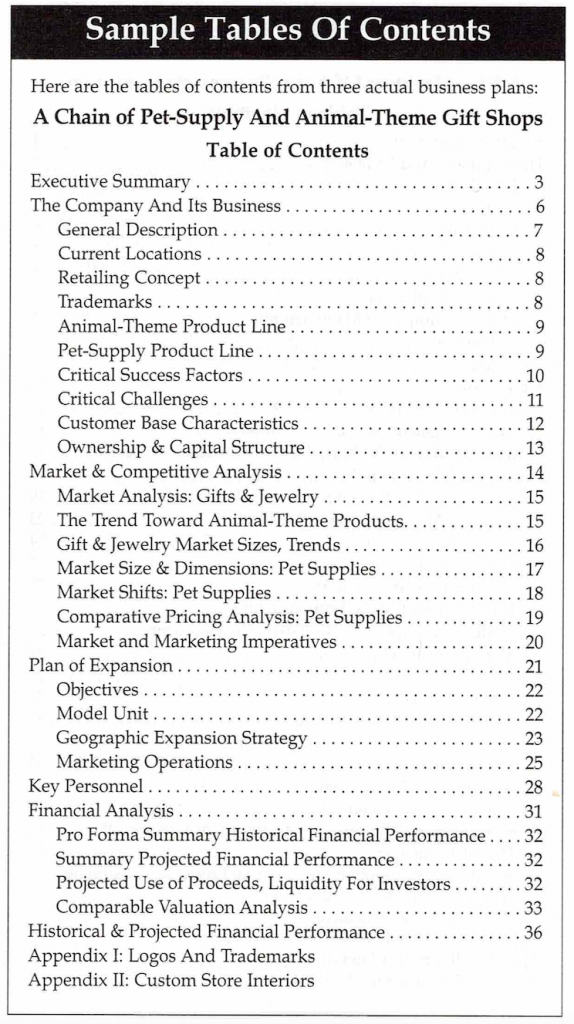
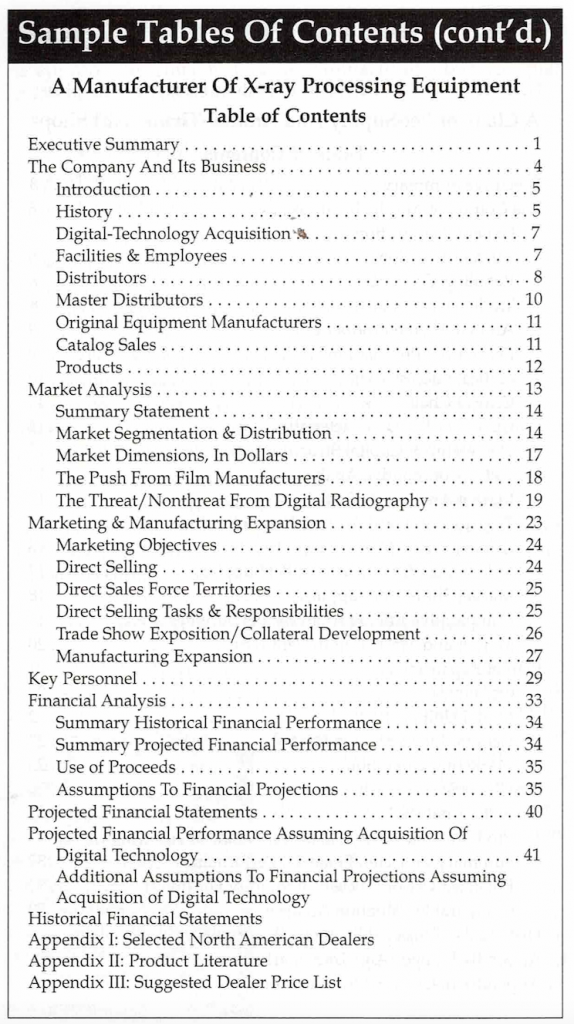
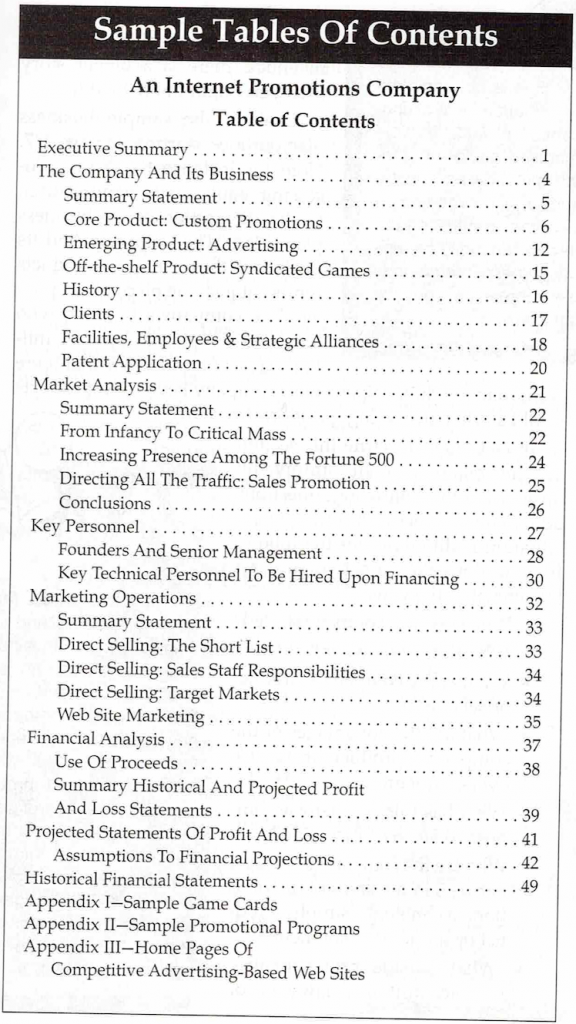
THE COMPANY AND ITS BUSINESSES
When investors put money into a business, they need to feel two emotions: comfort and confidence. Specifically, comfort that the business, the opportunity and the people who are running it are for real and confidence that the business can succeed. This section of the business plan is where entrepreneurs can build comfort in investors.
How? By describing everything about the business that is real, concrete and tangible. If the business is simply just an idea, this is hard to do. But, even if the business is a start-up engaged in product or service development but without revenues, there’s more of a story than you might think meets the eye.
Look at the business plan outlines above. Note for instance the X-Ray processing manufacturer. Under the section of the business plan titled The Company & It’s Business, the company’s products represent just one piece of the puzzle. Says the founder of this company, who has used the plan to raise $1 million, “I never knew that there were so many dimensions to our company beyond its products until I started answering questions from investors.”
In fact, you can write this section of the business plan simply by answering the following questions about your business. Of course, every situation is different, but the following list should get you there, or at least 90% of the way:
• When was this company started?
• Who else is an owner?
• What has this company accomplished since its inception?
• Who are the company’s strategic partners in the areas of distribution, technology, supply, product or service development?
• What outside professionals, i.e. accountants, lawyers, business consultants, have made a material impact on the company.
• What are the company’s facilities? Do they own or lease? What is the square footage?
• How many people does the company employ, and how are these employees organized? By product? By function? By department?
• What does the company own that is proprietary in terms of customer lists, technologies, licenses, patents, manufacturing techniques,
• How has the company been financed to date? Where did the capital come from?
• What is the company’s product or service?
• What are the advantages of the company’s product or service over competitors?
| Don’t Forget: Your business plan is not complete without a table of contents. In fact, a well-organized table of contents can draw an investor into the plan, whereas the absence of one will cause them to randomly browse, and perhaps prematurely lose interest and put the plan down. |
Remember as you answer these questions that the investor is looking to be comforted. Accordingly, provide lots of facts about cities, states, dates, and telephone numbers, that the investor can check if and when they start with their due diligence. For instance, if you outsource the assembly of your product, name the outfit that does it, provide their name, address, telephone number and any other contact information. Ditto for professionals. Got a patent? Great, provide the U.S. patent number.
| Shop Talk: Due diligence is an investigation into the business, its products, markets, facilities, competitors, and key employees. An investor’s due diligence can be long and painful. And more than a few companies have gone out of business for want of capital, while investors dither through due diligence. Therefore, a business plan should offer easily verifiable information to speed up the process of due diligence, and get the investor in a state of readiness to proceed with the deal. |
MARKET ANALYSIS
Taking once again the investor’s perspective, what is it that they want to know next? Well, assuming you’ve done a good job describing how you have organized resources in the preceding section, the immediate question becomes, what are these resources organized to capitalize upon? Specifically, what is the size of the market and what are the opportunities it offers.
| Kiplinger.com, Winter, 2018. This article was written with Ken Berman. It was part of a series of articles developed under an agreement with kiplinger.com to work with a variety of contributors and assist them in delivering actionable investment ideas each month. |
To write an effective market analysis, the entrepreneur must take off their business owner hat, and put on their captain of industry hat. Specifically, he or she must write the analysis with a supreme understanding (or at least the appearance of a supreme understanding) of the events and trends creating opportunity, as well as the trends shaping the market.
The overall objective of this analysis is to make a case for the market in which the company participates and thus by association, a case for the company’s product or service itself. Sometimes this is a tall order, even when the underlying market offers significant opportunity. Consider the above-mentioned manufacturer of X-Ray processing equipment.
The problem this company faced in making a case for its products could be summed up in a single word: digital. Specifically what angel investor, venture capitalist or investment banker would want to invest in conventional technology — the processing of X-Ray film — with diagnostic imaging standing on the brink of a digital revolution?
The company astutely made its case in the market analysis by asserting that the market for conventional technology had more legs to it than was readily apparent. It backed this assertion up with the following points:
• Digital imaging technology, though viable, would in most instances cost most users more than $1 million to install, and in addition, introduced a new challenge in data management that many healthcare institutions were unprepared to meet.
• Digital enhancements to conventional systems cost in excess of $100,000 — still outside the range of many healthcare practices.
• The filming and processing of X-Ray film represented a revenue center for many small practices and they would be unwilling to forgo this revenue when faced with capitated rates from health insurers.
• Chiropractic, veterinary, podiatry, D.O. and M.D. practices — the primary purchasers of conventional X-Ray processing equipment — were actually increasing in number.
• Sales of X-Ray film totaled some $7 billion annually with the market dominated by global manufacturers such as Fuji, Kodak and AGFA and 3M, that were not simply going to let a multi-billion market slip through its fingers.
• Most radiologists and physicians grew up on film-based diagnostic imaging and would resist a sudden shift to a new media.
• Finally, and most importantly, the United States, though a fertile market represented just a small portion of overall global demand. For many emerging industrial countries, seeking to establish even a base level of healthcare, digital imaging systems were not even a consideration. By contrast, however, conventional X-Ray suites, with conventional X-Ray film processors, were in hot demand in countries such as China, with more than 55,000 hospitals.
It’s important to note that a good market analysis doesn’t simply just make sweeping statements about trends in the market. Instead, it relies upon primary (i.e., original) research, secondary research which has been published, government statistics, white papers or studies supplied by trade associations, and authoritative articles in the trade press.
| A Good Deal: Unless your business plan contains sensitive information which can be used against you, do not use a confidentiality agreement. You stand a better chance of raising money if your plan’s distribution is wide, rather than restricted. |
According to angel investor Bill Simms in Sacramento California, who invests his own capital and for a large corporation, “I continue to turn down business plans where the market analysis isn’t wired tight and doesn’t make a convincing case for the company’s product or service.
Simms’ comment is well taken. After all, many investors are generalists, with no specific industry knowledge or experience. Therefore, as a form of protection against getting taken to the cleaners, many investors look for hard numbers backed up by third parties to support the market analysis. Another reason for generating a market analysis backed up by hard numbers has to do with the investor’s due diligence. That is, no one will ever invest in a company without taking some sort of independent look at the market. By offering analysis with authoritative sources, you provide the investor with a road map, which hopefully, gets him or her to the closing table faster than if they are out there floundering alone, trying to see if the market offers a real opportunity.
Keeping the above points in mind, here are some of the questions the market analysis of your business plan should answer.
• What is the market for your product or service in dollars?
• What is the market for your product in terms of units?
• What is the historical rate of growth in the market?
• If the market is segmented many ways, (i.e. the personal productivy segment of the software market) what were the rates of growth for the segments in which you are offering product or services.
• What is the projected rate?
• Why is there a deviation between historical and projected growth rates in the market for your product or service?
• What are the three primary determinants of demand?
• How is demand now satisfied in your industry; who are the major players?
• How has the market for the product changed over the past five years and why?
• How do you anticipate it will change going forward?
| Don’t Forget: For many equity investors, marketing operations represent the nib of the plan. After all, it’s what the company will do to capitalize upon an opportunity that’s going to increase earnings, and hence the value of the equity investor’s stake in the company. |
MARKETING OPERATIONS
The marketing operations section of a business plan makes the logical break between the opportunity defined by the analysis, and the specific strategies and tactics the company will deploy to capitalize on the opportunity.
When writing a marketing operations section of a business plan, keep in mind that it’s not so much a great market opportunity that gets investors excited, as much as a good solid marketing plan and a management team which inspires confidence that it can execute the plan.
Describing the marketing operations presents a different set of challenges for companies that are already selling their products and raising capital for expansion, versus those which are raising capital to commence their initial marketing efforts.
MARKETING OPERATIONS FOR ESTABLISHED COMPANIES
Naturally, companies with a track record have it all over upstarts. Why? Because they have some historically proven algorithm for generating sales. For instance:
• Each manufacturer’s representative will sell one unit a month.
• Every 1,000 catalogs sent in the mail generates approximately $1,200 in new orders
• The response rate on direct mail is 0.90% and the pay-up rate on resulting subscriptions is 97%.
• The telemarketers are able to make appointments 27% of the time, and the direct sales force closes on about 9% of those appointments.
• The ratio of sales to media purchases for our infomercials is about 1.50.
Even if a business owner has never thought too much about it, if there’s a history, there is some reasonably reliable relationship between marketing activities and sales. The value of this relationship in raising money is almost incalculable. Specifically, it will lend an air of credibility to the company’s projected financial performance — which for equity investors is perhaps the most important variable upon which their investment decision is made.
| Taking Action: Look at your historical financial performance and quantify the relationship between marketing activities, and the net result. Thus armed, you are then in a position to make your case for how financing more of the same will lead to increased profits. |
Although companies that are already selling their product or service have an advantage over those which aren’t, there are still challenges to be sure. Specifically, these companies must be able to convince investors that their current way of selling products is:
• The optimal method of marketing
• Scalable. That is, it will work as well or better when enlarged by an order of magnitude.
The challenge is particularly difficult if the company is selling its product, but not yet making any money. If the argument goes that “We simply need to run a higher unit volume over our fixed costs in order to reach profitability,” that’s fine. But be prepared to answer the following question: “Will throwing more money at marketing produce this additional business at a reasonable cost or will the additional expense offset the gains you are hoping for?”
MARKETING OPERATIONS FOR START-UP COMPANIES
Companies that haven’t yet sold their product have a much tougher row to hoe than their brethren with some experience in the marketplace. And of these, companies with new or revolutionary products have the toughest sell of all. Why? Because the investor will question whether or not 1) the customer will accept the product or service and 2) whether or not the distribution channel will accept the product. Remember Internet cafes? Most failed because consumers proved unwilling to purchase online services in a retail environment.
Keeping these challenges in mind, most business owners go wrong in the marketing operations section of their business plan by making the following claim:
Upon financing, the company will engage in an integrated sales and marketing program consisting of advertising, public relations, tradeshow exposition, direct selling through a company-paid sales force and the use of a manufacturer representative.
The problem with this approach as it relates to pitching an investor on your deal is that you are saying in effect, you really don’t know the best way to sell the product. When the investor starts to get the sense that you want to go to school on his or her money, then they will likely say to themselves, “Not with my money you aren’t!” Considering that only parents willingly pay for the education of another, and many of them with deep-seated reservations, you can only imagine what it does for early-stage financings.
The whole affair of raising capital for companies that have yet to sell a product or service is an imperfect Catch-22 at best. However, the best way to overcome the inherent flaws of the process is to reduce the marketing operations to one or two primary tactics.
For many companies, the old one-two punch delivers a majority of their overall sales anyway. Giant Dell Computer sells directly to consumers through catalogs and its own sales force. amazon.com sells books over the Internet. Amway sells door to door. And the venerable Thighmaster became a household name by using infomercials.
For start-up companies, the beauty of reducing marketing operations to a one-two punch is that it then becomes feasible to conduct test marketing on a low-cost basis. With actual results in hand, no matter how rudimentary they may be, the credibility of the business plan increases by a factor of 10.
To see just how simple test marketing can be consider the following low-cost techniques that almost any company could deploy.
Example 1: Business janitorial service claims in its business plan that it will use advertising in local newspapers promoting free trial for commercial landlords in exchange for re-evaluating their existing maintenance contract. Low-Cost Test: Run three advertisements in local newspapers, and record the response. When landlords call, use the occasion to poll them about needs, preferences and price sensitivities. Package these interviews as original market research to share with investors.
Example 2: A restaurant planning to franchise claims in its business plan that new sites will engage in so-called community-based marketing to draw customers from the surrounding three-mile radius. Low-Cost Test: Saturate three neighborhoods near the existing restaurant with hand-delivered flyers that have a coupon offer. Distribute approximately 1,000 flyers per neighborhood and record the response rate of consumers who bring these flyers into the restaurant to take advantage of the coupon offer. When customers come to the restaurant, offer a free dessert in exchange for completing a questionnaire. Compile these questionnaires and use the results as original market research in the business plan.
| Taking Action: Figure out how to conduct low or not cost test marketing and go do it! |
Example 3: The manufacturer of a line of handheld garden tools claims in its business plan that it will sell its products through mass-market distribution channels. Low-Cost Market Test: Develop a list of 25 questions for buyers of garden tools at 25 mass-market retailers. Focus the questions on the requirements to gain shelf space, minimum order sizes, policies on payments and returns, and the buyer’s beliefs about the level of competitiveness in handheld garden tools. Survey the buyers by telephone at each of the 25 targeted retailers. If a majority suggests a willingness to purchase products on a trial basis after a sales call from the company, compile their answers in the business plan, write the marketing operation section of the plan so that direct selling is the primary marketing activity.
| Don’t Forget: Any entrepreneur can make sweeping claims about what they will do once funded. But, in the eyes of the investor, it’s the entrepreneur who is basing their claims on experience, rather than supposition, who represent the better bet. |
As a parting comment, whether your company is established or not, here are the questions the marketing operations section of your business plan should answer.
• What are the company’s marketing objectives?
• What are the promotional tactics the company will deploy?
• What is the cost of each of these promotional tactics?
• What is the estimated or historical relationship between the company’s proposed tactics and the resulting product or service sales?
• What are the primary channels of distribution for this product or service?
KEY PERSONNEL
Most investors say they don’t even read business plans. But if you question them more closely, they will all tell you their own proprietary technique for skimming the plan to see whether or not the company merits a serious look. Many of these “proprietary” glances actually turn out to be remarkably the same. The investor reads the first paragraph of the executive summary, skims the balance of the executive summary, then turns to the key personnel section of the plan.
| A Good Deal: Advisory boards can be a great deal for companies, especially when it comes to bulking up the key personnel section of the business plan. Not only do members of an advisory board add intellectual depth to the company, but they increase the likelihood that outside investors seeing the plan for the first time will make some sort of personal connection with the company. |
It’s simply human nature. Investors want to see who’s running the show. They also want to see if there is any connection between themselves, and the people involved in the company. And take note, some connection, no matter how faint — as in ‘Their controller used to be a CPA at the accounting firm we used at my last company’ — can spell the difference between the investor deciding to take a closer look, and the investor deciding to take a pass for the moment.
But that’s just the first glance. Sooner or later the serious investor is going to settle down with the Key Personnel section of the plan to take a critical look at the people behind the company. While the old saying in real estate goes ‘Location, Location, Location’, the mantra for financing very tiny companies is ‘Management, Management, Management.” And for better or for worse, the first time a would-be investor meets the management team is in the biographical sketches written in the business plan.
GETTING THE RIGHT SPIN ON BIOGRAPHIES
So, how must the biographical sketches be spun to do their work? Overall, the biographies of the founders and senior managers must be cast in terms of concrete skills and specific accomplishments, rather than titles and educational trophies.
Why is this so? Because for a company with most, if not all of its history ahead of it, the investor needs some assurances that the members of the management team can execute. And the best way to offer this assurance is by showing a track record of execution.
Here is a biographical sketch cast two ways. Which one is more inspiring?:
James P. Morgan, Co-Founder & Director of Marketing
Mr. Morgan has more than 15 years of experience in consumer product marketing. Prior to co-founding the company, Mr. Morgan was associated with Northstar Industries. He joined the company in 1985 as a Marketing Associate, and during the next 15 years rose to successively more responsible positions with Northstar. Just prior to founding this company, Mr. Morgan was promoted to northeast regional marketing director of consumer products for Northstar Industries. Mr. Morgan earned a Bachelor’s degree in business administration from Boston College. Currently, he is active in several business and civic organizations.
Or…
James P. Morgan, Co-Founder & Director of Marketing
Mr. Morgan has more than 15 years of experience in consumer product marketing. During this time he has developed several critical skills related to the direct marketing of consumer products. Prior to co-founding the company, Mr. Morgan was associated with Northstar Industries. He joined the company in 1985 as a Marketing Associate, where his primary responsibility was telemarketing and involved qualifying prospects who responded to company advertisements. Mr. Morgan enjoyed above-average response rates, and as a result, was promoted to manager of telemarketing sales training. In this capacity, Mr. Morgan created and published a direct marketing manual which is still in use by the company today. After three years in this capacity, Mr. Morgan trained three individuals for his replacement and was promoted to a regional management position fulfilling advertising and marketing functions. Specifically, Mr. Morgan hired and was the point of contact for regional advertising agencies to ensure their efforts were consistent with the company’s national strategy and advertising campaign. In addition, Mr. Morgan oversaw the company’s direct sales in the region by participating in sales calls, recruiting new personnel, and directing quarterly sales promotions. Mr. Morgan left Northstar last year to form the company. His responsibilities now include marketing planning, and he will be responsible for recruiting and training the company’s sales and marketing staff. Mr. Morgan earned a Bachelor’s degree in business administration from Boston College. Currently is a member of the Direct Marketing Association, the Chamber of Commerce Council on Marketing 2000, and is an advisor to the board of directors of the downtown enterprise zone business incubation project.
| Don’t Forget: When writing the key personnel section of your business plan don’t be modest, and talk in terms of skills and experience, instead of previous titles. |
OVERCOMING A THIN MANAGEMENT TEAM
Companies raising money are by definition needy. Many times financing the addition of new personnel is the point of the business plan.
Still, it’s very difficult to overcome the challenges posed by an incomplete management team. After all, management is supposed to be what the investors are investing in. And if there’s no management in place, the question in the investor’s mind becomes what’s the point here?
One way to overcome this problem is to put in the biography of the individuals that will be hired once the company is funded. Investors know that it takes time to find employees, and they would prefer that entrepreneurs not do the looking on their nickel.
Therefore if two companies are exactly the same in every respect, except that one has identified who it will hire and the other has simply suggested that it will hire once funded, then the former company is a more attractive candidate than the latter in the eyes of the investor.
Granted, few emerging companies have this luxury. The fallback position would be to offer a menu of responsibilities and a biographical sketch of the person that the company would hire. Here are biographical sketches from a company that contemplated the expansion of a retail chain of animal theme gift shops. (The table of contents of this business plan was shown earlier in this chapter as well.) The only other biography alongside these was the founder’s.
• District Managers. Every five new stores opened will require a district manager. The duties of the district manager will be to maintain inventories at each of their locations, hire and manage personnel, staff locations when regular employee disruptions occur, manage cash and daily deposits, manage repair and maintenance of fixtures and equipment, create store displays and coordinate with the company’s merchandise buyer. Ideal candidates for district managers will have two years of experience in a retail environment.
• Regional Managers. Every 20 stores require the addition of a regional manager. The duties of the regional managers will be to oversee and manage the company’s warehousing operations, direct purchasing and product distribution for stores in their territory, hire and manage district managers, inspect locations, develop and assist in the execution of in-store promotions, analyze territory for potential new sites. Ideal candidates for regional managers would be district managers. Coming from the outside, ideal candidates would have 3 to 4 years of experience in managing multi-location retail environments.
• Chief Financial Officer, Controller. The company will hire a chief financial officer/controller in the first quarter after financing. The duties of the chief financial officer will be to establish disbursement controls, design and oversee multiple commercial banking relationships, implement cash management, initiate and maintain corporate banking relationships, and develop and oversee accounting and financial management information systems. The ideal candidate will have 10 to 15 years of experience with a publicly held retailer, specific knowledge about how to manage multi-location banking and cash management activities and undergraduate and graduate degrees in finance and/ or accounting.
• Marketing Manager. The company will hire a marketing manager during the first year following financing. The duties of the marketing manager will be to establish and manage database marketing operations, oversee and assist with new store opening promotions, oversee and assist with new store community-based marketing programs, and act as a marketing consultant to regional managers. The ideal candidate will have 10 to 15 years of multi-store marketing experience, good numerical and trend analysis skills, experience working with printers and graphic designers, and a graduate degree in marketing.
• Business Development Officers. At the conclusion of the second year following financing, the company will hire two business development professionals. The duties of the business development professionals will be to manage the build-out of 50 new stores per year. Specifically, to make final site selections, negotiate with landlords, hire and supervise contractors, hire and promote district and regional managers. Ideal candidates will have five to 10 years of experience in a retail chain with a demonstrated track record of successfully opening new locations.
• Buyer/Purchasing Manager. During the second fiscal year following financing, the company will hire a full-time buyer. More than operational expertise, this buyer will provide creative leadership, and help the company locate unique animal-themed products that its customer base will increasingly expect of our stores in clothing, pet products, gifts, cards and jewelry. To ensure the integration of this creative leadership at the store level, the buyer will also coordinate merchandising displays and holiday decorations. The ideal candidate will have a college degree, and at least five to seven years of experience purchasing for a multi-location retail chain.
Entrepreneurs gain mileage for putting in the sketches of the people they will hire because it shows critical thinking and planning on the part of the entrepreneur. Simply saying you will hire additional people is merely a declarative statement.
Another device for overcoming an incomplete management team is to offer projected organizational charts. Here are some sample charts for a company at one, two and three years after financing.
Again, critical thinking about how an organization will grow when funded will win over investors more often than sweeping statements about organizational expansion.
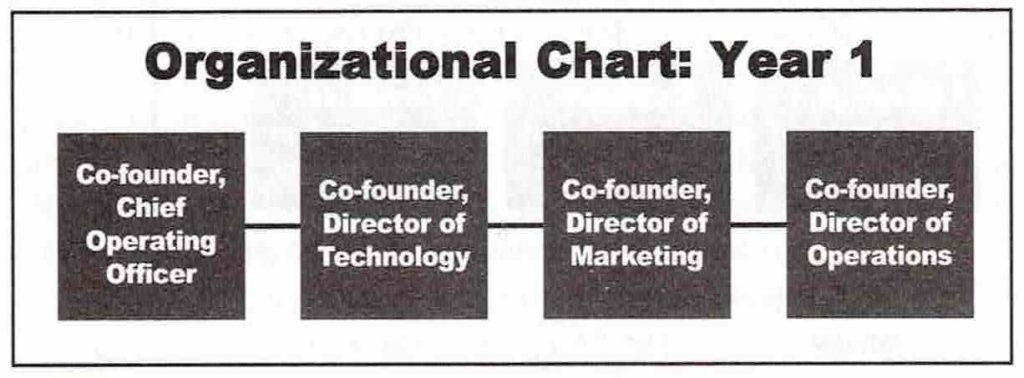
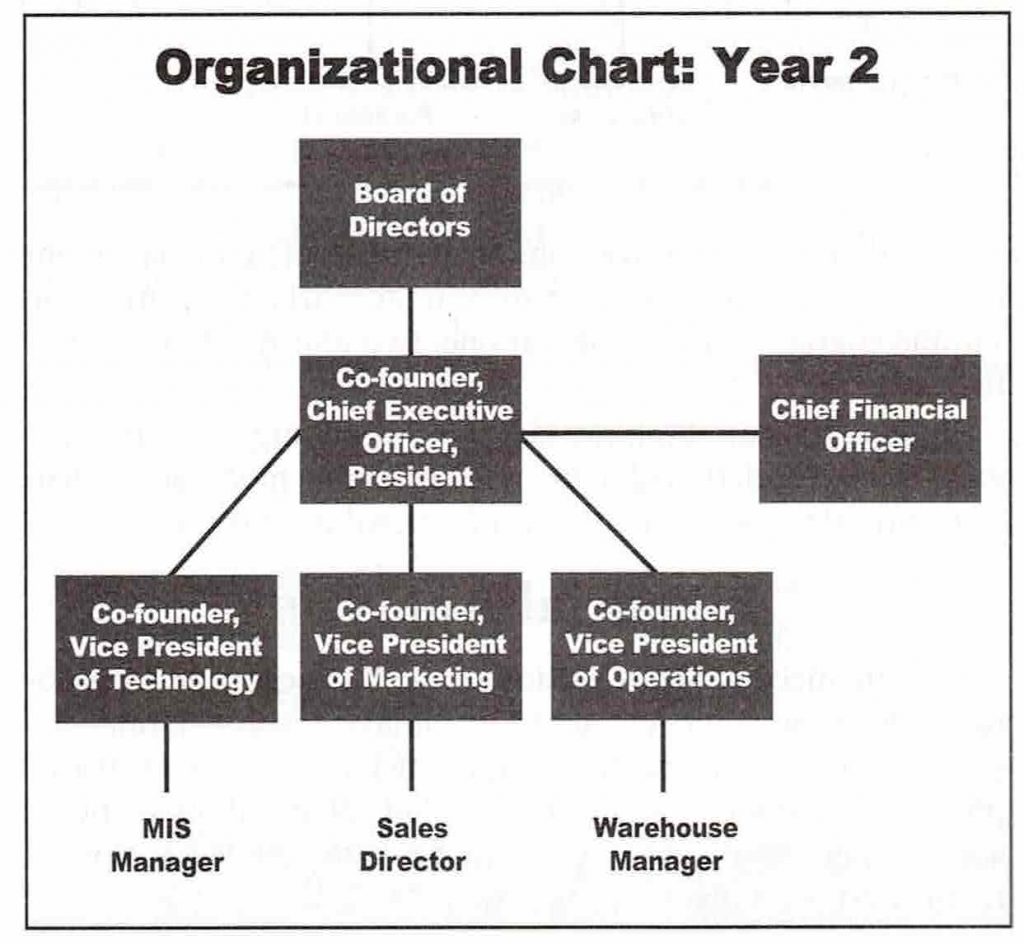
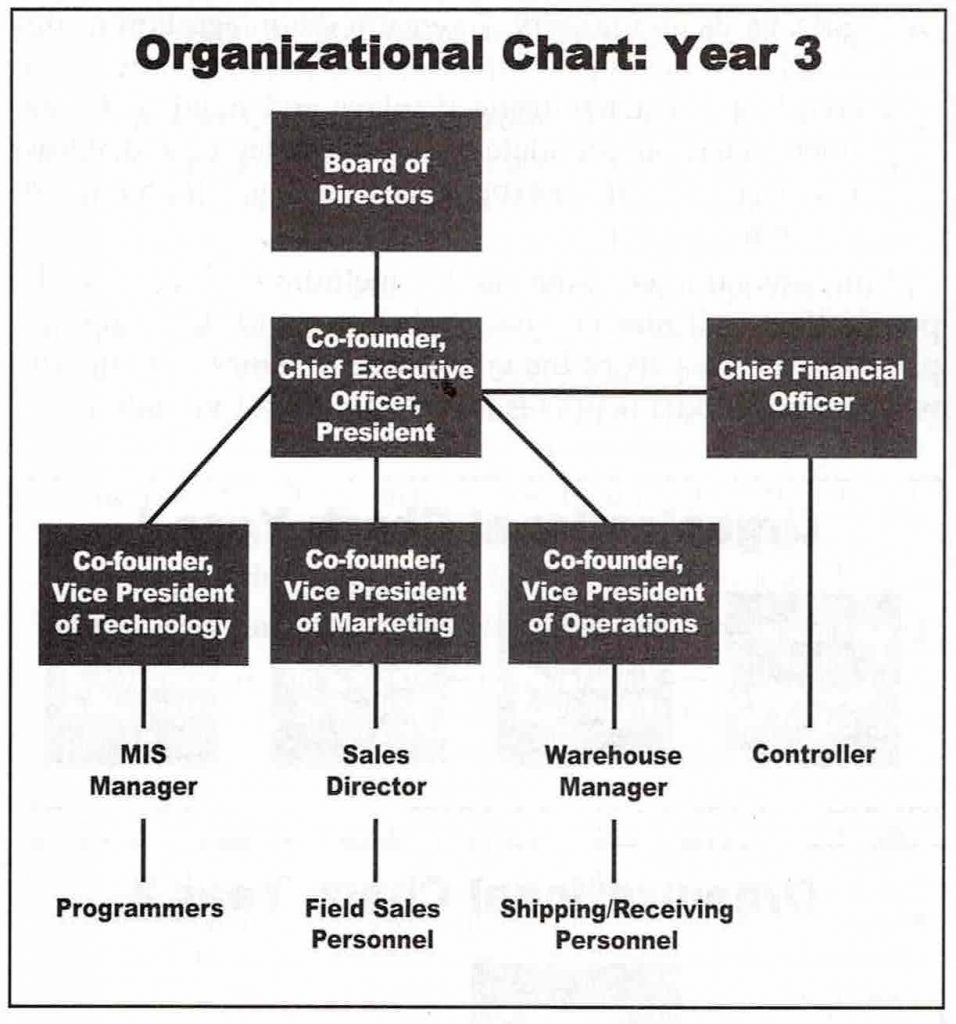
FINANCIAL ANALYSIS
The financial analysis section of the business plan incorporates many separate elements. These elements are: Summary Historical Financial Performance; Summary Projected Financial Performance; Use of Proceeds; Valuation Analysis; Detailed Financial Projections, Assumptions to Financial Projections; Detailed Historical Financial Statements.
VALUATION ANALYSIS
